The Verified Beef Production Plus (VBP+) program uses regular on-farm assessments to ensure Certified farms meet national standards for animal care, nutrition, biosecurity, food safety, environmental sustainability and more.
On-farm assessments take place every five years, with interim record assessments and self-assessments to ensure compliance. Assessments help identify both strengths and areas for improvement, supporting Canadian beef producers in maintaining responsible, ethical and transparent farming practices. They also provide assurance to consumers, investors and the wider public that beef production is safe and sustainable.
Continuous learning is a core part of VBP+. Producers have access to training on animal care, biosecurity, environmental stewardship, social responsibility and on-farm food safety. Developed with support by the Beef Cattle Research Council (BCRC), these science-based resources encourage the adoption of beneficial management practices, continuous improvement and innovation across Canada’s beef industry.
To become certified under the VBP+ program, beef producers must demonstrate they have the knowledge, practices and records in place to meet program requirements. These requirements are organized into subject areas that outline the VBP+ Standard, including foundational program expectations, critical control points (CCPs) and specific practices assessed across key areas of beef production. All requirements are developed using a science-based approach.
• Have an active relationship with a licensed veterinarian
• Ensure all cattle are properly identified and health records are kept
• Maintain documentation for activities that impact food safety and quality
• Demonstrate knowledge and commitment to animal welfare
• Understand and implement environmental stewardship practices
Critical control points are specific stages in the production process where biological, chemical or physical hazards can be prevented, eliminated or reduced to an acceptable level. These CCPs are the highest priority elements of the VBP+ assessment and receive greater scrutiny than general program requirements.
All CCPs share three common expectations:
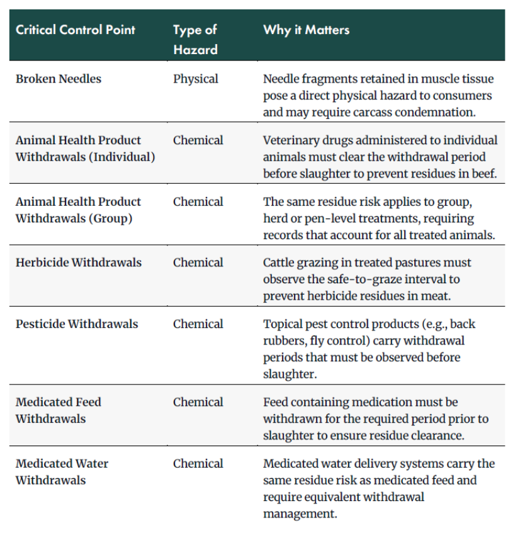
The following tables highlight expectations for each program area assessed through VBP+, including key practices and links to detailed information and additional resources.
Topic Area | VBP+ Expectation |
Handling | Use handling methods that minimize stress through appropriate equipment, trained personnel, minimal physical contact and suitable footing and lighting. |
Castration | Ensure castration is performed by trained personnel using proper equipment and techniques to minimize disease, infection, pain and distress. |
Dehorning/ Disbudding | Ensure disbudding or dehorning is performed by trained personnel using proper equipment and techniques to minimize pain and distress. |
Buller Syndrome | Recognize buller syndrome and intervene by removing the buller when necessary. |
Metabolic Disorders | Recognize the risk of metabolic disorders resulting from sudden or drastic dietary changes and seek professional advice when needed. |
Bloat | Recognize the causes of bloat and ensure trained personnel and appropriate equipment are available to provide treatment, seeking veterinary advice when needed. |
Lameness | Identify, manage and treat lameness. |
Branding | Ensure branding, when required, is performed by trained personnel using proper equipment and techniques to minimize pain and distress. |
Weaning | Ensure weaning practices aim to reduce stress while supporting calf health and monitoring for disease and distress. |
Shelter | Provide adequate natural or man-made shelter and manage manure accumulation or removal from the environment. |
Calving | Ensure management practices enhance calf and dam survival, with prompt support for animals in distress and veterinary assistance when needed. |
Looking for more information?
Refer to the VBP+ Section 05: Animal Care Manual for complete program requirements and guidance.
Topic Area | VBP+ Expectation |
Records | Maintain records of animal health, vaccinations and parasite control treatments. |
Treatment Errors | Treatment errors are documented, affected animal(s) are clearly identified and a veterinarian is consulted about changes to withdrawal times. |
Toxin Exposure | Recognize potential accidental exposure risks, document exposures, identify affected animals and seek veterinary or toxicology advice regarding withdrawal times. |
Veterinary Services | Have an established veterinarian-client-patient-relationship (VCPR). |
Prescriptions | All veterinary animal health products are obtained and used as per veterinary prescription. |
Death and Euthanasia Records | All deaths and euthanasia are recorded. |
Broken Needles | Procedures are in place to manage suspected or confirmed broken needle incidents, to maintain records and to ensure affected animals do not enter the food chain. |
Animal Health Products | Store, use and dispose of animal health products responsibly, following label directions, expiration dates and appropriate disposal guidelines. |
Animal Health Product Delivery Equipment | Equipment is clean, calibrated and can provide accurate dosing so withdrawal times can be accurately predicted. |
Restraint | Animals are restrained securely when delivering animal health products. |
Insect Control | Insect control practices are utilized with consideration for food safety risks, environmental impacts and animal welfare. |
Monitoring | Monitoring is conducted on a regular basis so intervention can be provided promptly if needed. |
Looking for more information?
Refer to the VBP+ Section 03: Animal Health Manual for complete program requirements and guidance.
Topic Area | VBP+ Expectation |
Biosecurity Protocols | Plan, adopt and execute protocols to initiate biosecurity measures specific to the operation. |
Animal Movements | Be aware of risks associated with animal movements and implement measures to minimize that risk. |
Comingling | Be aware of disease risk from comingling and implement measures to reduce that risk. |
Prevention of Disease Transmission | Attempt to prevent the transmission of disease through biosecurity measures. |
Visitors | Recognize the risks posed by visitors and implement measures to mitigate them. |
Zoonotic Diseases | Recognize the risk of zoonotic disease transmission and implement measures to protect personnel, visitors and the public. |
Reportable Diseases | Awareness and recognition of reportable diseases and how or when to report them to appropriate authorities. |
Disease Incident Management | Recognize the risk of infectious disease and maintain a response plan, including procedures for deadstock disposal in accordance with provincial and municipal regulations. |
Looking for more information?
Refer to the VBP+ Section 08: Biosecurity Manual for complete program requirements and guidance.
Topic Area | VBP+ Expectation |
Facility or Equipment Failure | Maintain an emergency response plan to ensure cattle continue to receive feed, water, care and shelter during operational disruptions. |
Cattle Emergencies | Maintain a response plan for cattle health emergencies and prioritize animal welfare and human safety. |
Human Health Emergencies | Be aware of and have a plan to address human health emergencies. |
Large Scale Disaster | Be aware of and have a plan to address potential disasters while prioritizing human safety, basic needs of cattle and emergency care or euthanasia. |
Looking for more information?
Refer to the VBP+ Section 10: Emergency Response Manual for complete program requirements and guidance.
Topic Area | VBP+ Expectation |
Water Management | A water management plan is in place to conserve, preserve and improve water sources on the operation. |
Manure and Soil Management | Be aware of and have a plan for safe handling, storage and application of manure. |
Biodiversity and Habitat Protection | Understand the natural habitats and biodiversity on the operation and implement practices that enhance biodiversity. |
Wildlife Conflicts | Monitor wildlife on the operation and implement practices that manage predation and other wildlife conflicts. |
Resource Efficiency | Implement practices to improve production efficiency and apply the principles of reduce, reuse and recycle to minimize environmental impact. |
Chemical Inputs | Store, use and dispose of chemical inputs responsibly to prevent contamination of soil, water and livestock, while complying with applicable legislation. |
Natural Resource Management | Monitor and manage natural resources to maintain or improve ecosystems, grazing areas and soil health. |
Air Quality | Be aware of and have a plan to address air quality issues, dangers and concerns. |
Foreign Materials | Recognize the risk of foreign material (such as wire) entering hides and carcasses and implement practices to minimize risk. |
Looking for more information?
Refer to the VBP+ Section 09: Environmental Stewardship Manual for complete program requirements and guidance.
Topic Area | VBP+ Expectation |
Nutritional Requirements | Provide feed in the proper quantity and quality to meet the nutritional requirements of cattle. |
Prohibited Feeds | Do not feed non-ruminant and prohibited feeds to cattle and recognize the need to contact the Canadian Food Inspection Agency (CFIA) if a non-ruminant feed is consumed. |
Cross Contamination | Implement practices and maintain records to prevent feed cross-contamination, including when using medicated feed or managing multiple species. |
Bedding and Supplements | Source bedding and supplements from known, safe and reliable suppliers and use feed additives appropriately. |
Water | Ensure water is provided in the proper quantity and quality to meet the requirements of cattle. |
Snow | If using snow as a water source, maintain a plan to monitor cattle and weather and provide a backup supply of water. |
Forage and Grain Management | Maintain a management plan to document forage and grain production. |
Foreign Materials | Understand and minimize the risks associated with consumption of foreign materials. |
Looking for more information?
Refer to the VBP+ Section 04: Animal Nutrition Manual for complete program requirements and guidance.
Topic Area | VBP+ Expectation |
Medicated Feeds | Maintain and follow a plan for the safe use, storage, delivery, mixing, distribution and record-keeping of medicated feed and medications. |
Feed Errors | Document medicated feed errors, identify affected animals and consult a veterinarian regarding withdrawal time adjustments. |
Dispensing Equipment | Ensure equipment used to receive, mix, store or deliver medicated feed or water is properly maintained, calibrated, operated and cleaned. |
Looking for more information?
Refer to the VBP+ Section 04: Animal Nutrition Manual for complete program requirements and guidance.
Topic Area | VBP+ Expectation |
Pre-shipping | Check records prior to shipping and maintain documentation of the record check, including the person responsible and the date completed. |
Transport | Maintain and follow a transport plan to ensure livestock are transported safely without undue suffering or injury. |
Compromised or Unfit Animals | Be aware of animals that should and should not be loaded and regulations regarding transport of compromised and unfit animals. |
Transfer of Care | Be aware of producer responsibilities surrounding transfer of care (TOC) and the care of animals being transported. |
Looking for more information?
Refer to the VBP+ Section 07: Transportation Manual for complete program requirements and guidance.
Topic Area | VBP+ Expectation |
Euthanasia | When necessary, animals are euthanized in a timely and effective manner. |
Euthanasia Procedure | Maintain proper training and equipment to ensure personnel are able to safely and humanely euthanize an animal. |
Deadstock | Recognize the risks associated with infectious, zoonotic and reportable diseases in deadstock, post-mortem materials and necropsy remains and follow appropriate precautions. |
Looking for more information?
Refer to the VBP+ Section 06: Vulnerable, Distressed and High-Risk Cattle Manual for complete program requirements and guidance.
Topic Area | VBP+ Expectation |
Learning and Training | Engage in learning and training opportunities that match operational requirements and goals. |
Work Environment | Work to provide a productive and healthy work environment through effective staff management. |
Health and Safety | Address health and safety issues to ensure all personnel have the knowledge and equipment needed to safely complete their duties. |
Looking for more information?
Refer to the VBP+ Section 11: Training & Mentoring Manual for complete program requirements and guidance.
Topic Area | VBP+ Expectation |
Innovation | Continue to explore and implement new practices and/or technologies. |
Code of Ethics | Establish clear values and a code of ethics to operate under. |
Community Involvement | Maintain involvement in the community. |
Production Efficiency | Use knowledge, records and data to identify opportunities for continuous improvement and enhance production efficiency. |
Looking for more information?
Refer to the VBP+ Section 02: Community Leadership & Social Responsibility Manual for complete program requirements and guidance.
This resource was developed through funding provided by the Sustainable Canadian Agricultural Partnership, a five-year investment by federal, provincial and territorial governments.
Updated August 2026