SIMPLE.

PRACTICAL.

TRUSTED.

VBP+ BLOG & NEWS

Industry News

This post was developed in collaboration with the Canadian Roundtable for Sustainable Beef (CRSB) and summarizes information found on the CRSB Certified website.

Operations certified under Verified Beef Production Plus (VBP+) are also Canadian Roundtable for Sustainable Beef (CRSB) Certified. We encourage all producers to take full advantage of the benefits offered by both certifications. Read below to review the requirements that enable you to maximize the value of your CRSB Certification.

One Missed Step Is Value Lost

As a CRSB Certified operation, you have the opportunity to participate in certified supply chains, and you could be eligible for incentives like Cargill Qualifying Cattle Credits which reward producers for providing cattle that move through Certified operations from birth up to and including the primary processor at Cargill.

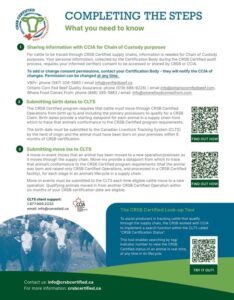
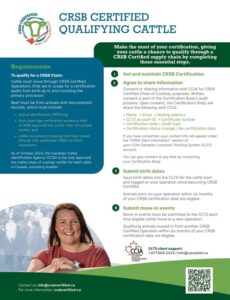
To be considered an active CRSB Certified operation, and for cattle to qualify for certified supply chains, know the following steps are required:

  1. Maintain certification through a CRSB-approved certification body (like VBP+)
  2. Consent to sharing your operation’s information with CCIA for chain of custody purpose
  3. Submit birth dates to the Canadian Livestock Tracking System (CLTS) for animals born and tagged on your operations
  4. Submit move-in events to the CLTS every time cattle move to a new operation

Consent to Sharing Your Operation’s Information with CCIA

Log in to your Canadian Livestock Tracking System account and double-check that it shows “CRSB Client Information” under My Account. 

  • If this section does not appear, it means that you have not consented to sharing, the CLTS won’t see you as an active CRSB Certified operation, and your calves won’t have a chance to qualify for supply chains or qualifying cattle credits.
  • The only information that will be shared with CCIA for chain of custody purposes is your operation name, email, mailing address, CLTS account ID, certification date, audit type, and a certification status change / de-certification date.

To update your settings, contact VBP+ (info@verifiedbeef.ca or call 587-328-5980) and request your consent be added to your account.

CRSB Certified – Maximizing Value for Cow-Calf Producers

As a cow-calf producer, you start the chain, so it is important that you enter your calf birth dates in CLTS.
Birth dates (or birth date range) provide a data starting point for that tag and animal in the CLTS (CRSB Certified supply chain) system.

• Whether you market your calves through an auction market, online marketing platform or a direct marketing group, share your certificate number and make it known that you would like any descriptions of your calves to include your CRSB and VBP+ Certification and that your birth dates have been submitted.
• If you sell directly, let them know you are CRSB and VBP+ Certified and that birth dates (individual or range) for your calves have been submitted to the CLTS.
• Sell to a Certified feedlot or backgrounder where possible, and encourage them to do a move-in event in the CLTS to keep the chain going and keep you both eligible for incentives!
• Current operations certified by VBP+ can be visually validated through the VBP+ Online Producer Sales Listing.
• Ontario feedlots certified by Ontario Corn Fed Beef program are also listed here.

As a Certified feedlot or backgrounder, look for cattle from certified operations. Let your cattle buyers and auction markets that you deal with know you are certified and actively looking for certified calves to buy. Ask your cattle suppliers if they are certified and check that they have consented to sharing information and their birth dates (individual or range) have been submitted to start the chain. 

Buying calves this fall? Submit move-in events to the CLTS every time cattle move to a new operation.

Make sure you submit move-in events in your CLTS account for all cattle that move into your operation. This keeps the chain of custody going to show that animals have come from Certified operations from birth to processing. 

  • If you know the cow-calf operation that cattle came from, contact them to encourage sharing their operation information and submitted birth dates in the CLTS.

Using the CRSB Certification Search Tool

The CRSB collaborated with CCIA to integrate a CRSB Certification Status tool in the CLST/indicator number to view the CRSB Certified status of an animal’s CRSB Certified status by tag/indicator number. Use this tool to verify CRSB Certified status of purchased animals.

Check out the CRSB Certified factsheet, FAQ and June webinar for more.

For help with any of the steps described in this article, contact the CRSB:

You can contact the Client Support Team at CCIA for assistance with submitting data on CLTS at 1-877909-2333 or info@canadaid.ca.

Contact the CRSB if you have any CRSB Certified program questions.
Info@crsbcertified.ca
Facebook
X
LinkedIn
Threads
testing beef cattle

By now, you’ve likely heard of Foot and Mouth Disease (FMD), a disease known for being extremely contagious and extremely severe. In the news right now, FMD strikes panic in the Canadian beef industry. That’s why it’s key that each and every one of us does our part to prevent the introduction of FMD into our Canadian cattle herd.

Fast Facts About FMD

  • Occurs in livestock and wildlife with cloven hooves – cattle, pigs, sheep, goats, bison, elk, deer, wild boars, etc.
  • Many animals recover, but are left in a weak state
  • Found in 77% of the global livestock population – Africa, Middle East, Asia, and some parts of South America
  • Spread by contact with bodily fluids from affected animals, contaminated animal products, food, feed, equipment, clothing, footwear, or hands
  • Can be spread long distances by the airborne virus
  • Humans can carry the virus for up to 36 hours in the throat
  • There is no treatment

Source: Foot and mouth disease | Alberta.ca

Signs of FMD in Cattle

  • Sores and then blisters/ulcers on feet, nose, mouth, udder, scrotum
  • Excessive saliva and drooling
  • Lack of desire to move
  • Fever
  • Low appetite
  • Reduced milk yield
  • Loss of body condition
  • Occasional abortions

Source: Foot and mouth disease | Alberta.ca

What to Do If You Suspect a Case of FMD

FMD is a reportable disease and must be reported to the Canadian Food Inspection Agency (CFIA). Whether a case is suspected or confirmed, report it to the chief veterinary office in your province within 24 hours.

Source: Foot and mouth disease | Alberta.ca

Tips for Travellers

  • Declare all meat and other animal products brought into Canada (includes semen, embryos, and hides)
  • If coming from a country with FMD, avoid farms, parks, zoos, feed mills, equipment, and livestock for 14 days
  • If you must come into contact with an above area:
    • Clean and disinfect footwear, or ideally, dispose of footwear worn abroad
    • Dry clean clothing worn abroad
    • Thoroughly shower and clean under fingernails
    • Disinfect all personal belongings
    • Follow all biosecurity procedures at the facility
  • If you live on a farm, avoid going home for 36 hours by staying at an alternative residence where someone can bring you clean clothing and footwear to wear home

Source: Foot and mouth disease | Alberta.ca

What Happens If FMD Reaches Canada

If FMD was identified in Canada, the CFIA would identify exposed premises, cull exposed and high-risk potentially exposed livestock, and decontaminate the environment. Disposal would occur by incineration or burial.

The Canadian beef industry is continually advocating for the development of an FMD vaccine bank. However, routine FMD vaccination is not allowed in Canada for several reasons. Primarily, routine blood tests cannot distinguish vaccinated animals from infected ones, making vaccinated livestock ineligible for export with Canada’s trading partners. If Canada did widely vaccinate, we would lose “FMD-free without vaccination” status. Many of Canada’s trading partners, including the US, restrict imports from countries that vaccinate for FMD, even for animals that are proven to not carry the virus.

However, if prevention and disease control fail, Canada may vaccinate for FMD to reduce widespread culling. To regain “FMD-free without vaccination” status, Canada would have to wait 3 months after the last case, or in the case of vaccination, 3 months after the slaughter of the last vaccinated animal.

If widespread culling occurs, producers will be compensated for the market value of their lost animals.

Source: Questions and Answers – Response to Foot-and-Mouth Disease (FMD) – Canadian Food Inspection Agency (canada.ca)

Tips for Preventing FMD Introduction to Your Farm

  • Prevent visitors from accessing your livestock
  • Prevent livestock contact with wildlife
  • Regularly disinfect footwear, clothing, and equipment
  • Keep records of people, livestock, feed, supplies, and equipment moving on and off your farm
  • Keep new animals separate for an initial quarantine period (at least 5 days)

Source: Questions and Answers – Response to Foot-and-Mouth Disease (FMD) – Canadian Food Inspection Agency (canada.ca)

More Information

To learn more about FMD and biosecurity preparedness, check out the following resources.

VBP+ Producer Reference Manual – Vulnerable, Distressed & High-Risk Cattle, Biosecurity and Emergency Response Plan modules in particular

VBP+ Training 2.0 on the Canadian Cattle Learning Center

On February 20, 2020, amendments were made to the Health of Animals Regulations: Part XII: Transport of Animals. While the name of this legislation may not ring a bell, most producers caught word of the reduction in maximum allowed intervals without feed, water, and rest for animals in transport. However, this is far from the whole story.

Since the amendments came into effect on February 20, 2020, any animal left at a slaughter facility or assembly centre (i.e. auction market, assembly yard, or independent holding facility associated with a slaughter establishment) had to be accompanied by a written transfer of care document. This document ensures that the individual responsible for the care of the animal(s) in question is clearly identified at all times, which in turn defines who is accountable for welfare decisions.

For some producers, the point at which this regulation came into effect is a source of confusion. The Canadian Food Inspection Agency (CFIA) implemented a two year compliance promotion period for the enforcement of the new maximum feed, water, and rest intervals. This means that until February 20, 2022, CFIA is focusing on education and awareness rather than strict enforcement of the new regulations. However, contrary to what many producers have been told, this does not apply to transfer of care documents. That is, producers are currently required by law to implement this documentation.

The guidelines for these written documents are quite general. There is no prescriptive format for the document, but instead, CFIA provides a list of required information to be included. The necessary information includes:

  1. The names of the transporting company and driver;
  2. The receiving company and representative;
  3. The condition of the animal(s) on arrival;
  4. The date, time, and place of the last feed, water, and rest;
  5. The date, time, and place of arrival;
  6. Notes regarding animal welfare concerns, dead animals found, and resulting actions;
  7. Acknowledgement from the receiver indicating receipt of the animal(s) and acceptance of the responsibility for care.

Producers do not have to provide transfer of care documents to commercial carriers, because responsibility for animal care is already transferred to the transporter upon release of the animals by the producer under the Health of Animals Regulations. As a result, a driver can refuse to drop off a load due to animal welfare concerns, since they are responsible for the care of the animals at that time. Similarly, receivers should document any welfare concerns on arrival to avoid being held accountable for issues that occurred before they were responsible for the care of the animal(s). Notably, CFIA states that this is an important step, because it helps receivers avoid declining a load and prolonging non-compliant animal transport to avert blame for the welfare issues.

Transfer of care documents should be kept on file for two years. This rule is important to tracking accountability for care in case of a welfare investigation. Read the amendments to the Health of Animals Regulations here.

Luckily, VBP+ provides a template for a transfer of care document that is available to all producers, whether or not they are trained and/or certified in the VBP+ program. This helps producers save time and get their cattle passed on quickly and responsibly!

Find the VBP+ Transfer of Care Record template here.

Check out all the record templates and examples that VBP+ offers here.