SIMPLE.

PRACTICAL.

TRUSTED.

VBP+ BLOG & NEWS

September

The Animal Care section of the new VBP+ Producer Reference Manual is a great resource for producers to brush up on animal management techniques. Like the other sections, Animal Care includes self-assessments for certified operations to check their progress towards meeting the requirements for a successful audit. In addition, this section is packed full of great information on a variety of animal care topics, as well as other resources for producers.

Animal Care in the manual is divided into five parts: NFACC Code of PracticeHandlingProceduresHousing and Facilities, and Reproduction and Calving. Each sub-section contains key information for producers looking to get certified, or who want to learn more about these topics.
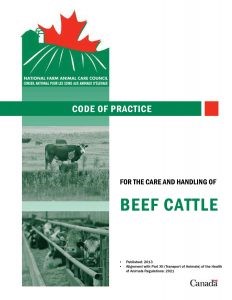
 

The NFACC Code of Practice outlines recommended and required practices for Canadian beef producers. Read it here.

The first sub-section, NFACC Code of Practice, helps producers interpret the structure of this important document. The National Farm Animal Care Council (NFACC) published the new Code of Practice for the Care and Handling of Beef Cattle in 2013. This document upholds the standard for beef cattle management in Canada, and was developed in partnership amongst producers, animal welfare groups, and other stakeholders. Check out the Animal Care section to better understand how to interpret the recommendations and required practices outlined in this document.

Next, the Handling sub-section discusses low-stress cattle handling and its benefits to producers and animals. Specifically, this part of the manual describes specific guidelines for handling tools and principles for animal movement. Additionally, this section ties into the NFACC Code of Practice by providing producers with the recommended handling practices from this document.

Procedures helps producers understand specific guidelines for a variety of common on-farm techniques, including restraint, branding, disbudding/dehorning, castration, weaning, predator control, and tail docking. These components help producers best accomplish these tasks while balancing animal welfare, practicality, efficiency, and effectiveness. For producers new to VBP+ or who want to clarify best practices, this part of the Animal Care section is key. As a bonus, links to several helpful resources from the Beef Cattle Research Council are provided.

The Housing and Facilities sub-section describes how to best manage animal care outside, in confinement, and with specific facilities. This part of the manual lays out key considerations in each of these scenarios and helps producers improve the environment their cattle are exposed to in order to maximize animal health, welfare, and performance.

Finally, Reproduction and Calving Management discusses facilities, monitoring, colostrum, calving issues, and prevention of undesired pregnancies. These topics combined allow producers to improve their calving practices so as to maximize success in terms of calf survival. NFACC guidelines are also provided throughout to help producers note key points from this document.

Together, the sub-sections of Animal Care help producers enhance their cattle management to improve animal health and welfare, which in turn improves performance and profitability for VBP+ operations. Stay tuned for the next section of the VBP+ Producer Reference Manual!

abandoned farmstead in winter

Foreign objects can present a food safety issue for consumers who purchase meat products from affected animals later on down the supply chain, and can also impact animal health and welfare prior to slaughter. Luckily, foreign objects are a risk which producers can mitigate on-farm.

In most cases, foreign objects enter animal carcasses in one of two ways. Cattle can either consume them, or they can penetrate the hide and end up lodging within tissues.

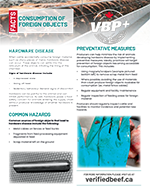
Consumption of foreign objects fact sheet

When cattle consume foreign objects, the material usually gets caught in the reticulum, where it can irritate the tissue within this chamber and cause pain for the animal. At this stage, cattle present a condition called hardware disease, which causes them to perform poorly and show general signs of discomfort such as a depressed state, poor appetite, and sedentary behavior.

Unfortunately, there are many common foreign objects found on-farm which cattle can easily consume. For example, metal cables on fences or feed bunks can be chewed and break if poorly maintained. Alternatively, fragments of metal or other material left on the ground or deposited in feed from processing equipment are easily consumed by cattle.

The best way for producers to prevent the risk of hardware disease, and its associated food safety concern, is to prevent access to foreign objects. If the operation processes feed, magnets or scalpers can be used to remove scrap metal from feed before it is offered to cattle. Where possible, producers should avoid using materials that could easily produce hardware, such as metal fence cables. If this is not possible, producers should regularly maintain equipment and facilities to avoid fragments becoming accessible to animals. Finally, regular inspection of feeding areas for foreign objects and monitoring of cattle and facilities for incidence and new hazards is key.

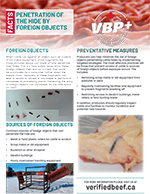
In other cases, cattle do not eat the foreign object, but rather rub against one such that it penetrates their hide. If these foreign objects become lodged in muscle and the producer is not aware, meat containing these foreign objects can enter the food chain and lead to consumer distrust and potential injury. In some cases, recalls or refusals of carcasses or portions of a carcass at processing plants may occur.

Sources of foreign objects that can penetrate cattle hides are relatively similar to those that can cause hardware disease. Scrap metal, derelict buildings, and poorly maintained equipment are easy for cattle to rub against and pick up metal fragments. However, a few common sources are unique to this route of entry. Buckshot or other shrapnel in areas where birds are hunted can enter the animal. Alternatively, metal or hard plastic rollers used for cattle to scratch can deposit small fragments in the hide.

VBP+ penetration of the hide by foreign objects

Much like the hazards, the solutions to foreign objects entering animal hides are very similar to those that prevent the consumption of foreign objects. Removing scrap metal and old equipment and restricting access to derelict buildings, metal or hard plastic rollers, or bird hunting areas will aid in preventing access to fragments that could enter the hide. Regular maintenance of equipment and facilities will also reduce risk. Finally, while preventive measures should be emphasized, producers should monitor and document incidence in cattle to avoid entry of foreign objects into the food supply chain.

Regardless of the route of entry, handling foreign objects with cattle relies on the same basic principle: producers should prioritize prevention and maintain good maintenance and inspection to avoid food safety hazards entering the food supply chain.

To brush up on foreign objects, check out VBP+’s two fact sheets on Consumption of Foreign Objects and Penetration of the Hide by Foreign Objects.