SIMPLE.

PRACTICAL.

TRUSTED.

VBP+ BLOG & NEWS

October

Canada ushers in the fall season with beautiful colors, cooling weather, reduced daylight hours, migrating birds, mating ungulates like deer and elk, and scavenging bears. Depending on conditions in your region, cattle are often still out on pasture, on hay fields, swath or bale grazing or utilizing cereal crop residues.

Fall also coincides with hunting season. Producers can maintain the balance of biodiversity and wildlife conflict through managed and controlled hunting access. While managing access to your property by hunters, it is important to ensure these hunters are respectful of the presence of cattle on your operation to reduce the risk of unintended foreign materials in beef carcasses.

The potential of birdshot and buckshot in beef carcasses is an ongoing concern. As a landowner and/or manager of cattle, it is important that prevention and risk reduction remain a priority.

How to protect cattle and consumer trust by mitigating the risk of birdshot and buckshot in beef carcasses:
  • Post “No Hunting” or “No Trespassing” signs on your property so only hunters with permission, and who have been informed of where cattle are located, hunt on your property.
  • Inform hunters of your operation’s commitment to reducing the risk of foreign material contamination in carcasses and confirm their commitment to responsible hunting practices.
  • Ensure that pastures and fields where cattle are grazing or feeding have good fencing to prevent cattle from straying into property where hunters are not aware of their presence.
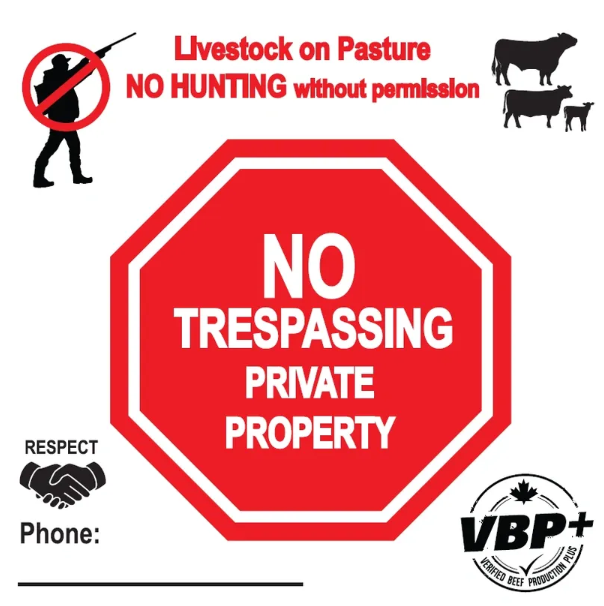
Livestock on pasture, No hunting without permission, no trespassing VBP+ sign
Need signage for hunting season? VBP + has you covered! Note: Shipping is temporarily paused due to the postal strike, but will resume once the strike is resolved.
How to reduce risk when using firearms:
  • Consider zone of fire when using firearms to deter predators (e.g., coyotes, birds) near herds, feedlots or silage pits.
  • Don’t use shotguns for loud sounds to help move difficult cattle from bush areas.
  • Support training for new firearm users on the operation.
  • Treat every shot as having the potential to travel and spread.
  • Consider zone of fire and the right tool for the right job when performing necessary euthanasia.
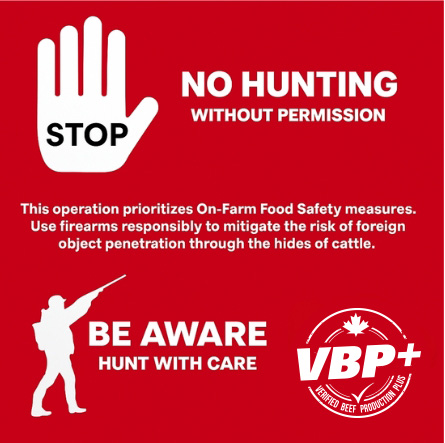
Birdshot and buckshot contamination of beef carcasses can be a problem caused by irresponsible hunting or handling practices, so it is worth the effort to prevent these production-limiting, costly physical hazards that threaten consumer trust.
Facebook
LinkedIn
X
Threads

This post was developed in collaboration with the Canadian Roundtable for Sustainable Beef (CRSB) and summarizes information found on the CRSB Certified website.

Operations certified under Verified Beef Production Plus (VBP+) are also Canadian Roundtable for Sustainable Beef (CRSB) Certified. We encourage all producers to take full advantage of the benefits offered by both certifications. Read below to review the requirements that enable you to maximize the value of your CRSB Certification.

One Missed Step Is Value Lost

As a CRSB Certified operation, you have the opportunity to participate in certified supply chains, and you could be eligible for incentives like Cargill Qualifying Cattle Credits which reward producers for providing cattle that move through Certified operations from birth up to and including the primary processor at Cargill.

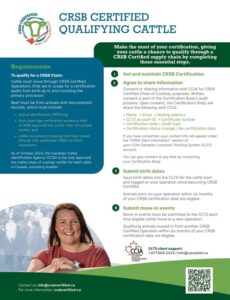
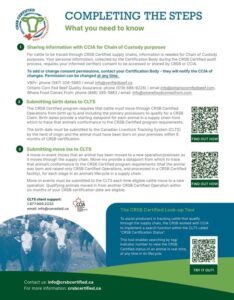
To be considered an active CRSB Certified operation, and for cattle to qualify for certified supply chains, know the following steps are required:

  1. Maintain certification through a CRSB-approved certification body (like VBP+)
  2. Consent to sharing your operation’s information with CCIA for chain of custody purpose
  3. Submit birth dates to the Canadian Livestock Tracking System (CLTS) for animals born and tagged on your operations
  4. Submit move-in events to the CLTS every time cattle move to a new operation

Consent to Sharing Your Operation’s Information with CCIA

Log in to your Canadian Livestock Tracking System account and double-check that it shows “CRSB Client Information” under My Account. 

  • If this section does not appear, it means that you have not consented to sharing, the CLTS won’t see you as an active CRSB Certified operation, and your calves won’t have a chance to qualify for supply chains or qualifying cattle credits.
  • The only information that will be shared with CCIA for chain of custody purposes is your operation name, email, mailing address, CLTS account ID, certification date, audit type, and a certification status change / de-certification date.

To update your settings, contact VBP+ (info@verifiedbeef.ca or call 587-328-5980) and request your consent be added to your account.

CRSB Certified – Maximizing Value for Cow-Calf Producers

As a cow-calf producer, you start the chain, so it is important that you enter your calf birth dates in CLTS.
Birth dates (or birth date range) provide a data starting point for that tag and animal in the CLTS (CRSB Certified supply chain) system.

• Whether you market your calves through an auction market, online marketing platform or a direct marketing group, share your certificate number and make it known that you would like any descriptions of your calves to include your CRSB and VBP+ Certification and that your birth dates have been submitted.
• If you sell directly, let them know you are CRSB and VBP+ Certified and that birth dates (individual or range) for your calves have been submitted to the CLTS.
• Sell to a Certified feedlot or backgrounder where possible, and encourage them to do a move-in event in the CLTS to keep the chain going and keep you both eligible for incentives!
• Current operations certified by VBP+ can be visually validated through the VBP+ Online Producer Sales Listing.
• Ontario feedlots certified by Ontario Corn Fed Beef program are also listed here.

As a Certified feedlot or backgrounder, look for cattle from certified operations. Let your cattle buyers and auction markets that you deal with know you are certified and actively looking for certified calves to buy. Ask your cattle suppliers if they are certified and check that they have consented to sharing information and their birth dates (individual or range) have been submitted to start the chain. 

Buying calves this fall? Submit move-in events to the CLTS every time cattle move to a new operation.

Make sure you submit move-in events in your CLTS account for all cattle that move into your operation. This keeps the chain of custody going to show that animals have come from Certified operations from birth to processing. 

  • If you know the cow-calf operation that cattle came from, contact them to encourage sharing their operation information and submitted birth dates in the CLTS.

Using the CRSB Certification Search Tool

The CRSB collaborated with CCIA to integrate a CRSB Certification Status tool in the CLST/indicator number to view the CRSB Certified status of an animal’s CRSB Certified status by tag/indicator number. Use this tool to verify CRSB Certified status of purchased animals.

Check out the CRSB Certified factsheet, FAQ and June webinar for more.

For help with any of the steps described in this article, contact the CRSB:

You can contact the Client Support Team at CCIA for assistance with submitting data on CLTS at 1-877909-2333 or info@canadaid.ca.

Contact the CRSB if you have any CRSB Certified program questions.
Info@crsbcertified.ca

Facebook
X
LinkedIn
Threads