
SIMPLE.

PRACTICAL.

TRUSTED.

VBP+ BLOG & NEWS

The Two-Legged Factor in Animal Welfare

Often in the beef industry, producers de-prioritize their own physical and mental health. It’s easy to justify sacrificing our own wellbeing for the sake of getting the job done. But what if leaving humans last on the list has an impact on more than just people?

Dr. Michelle Calvo-Lorenzo is the Chief Animal Welfare Officer for Elanco. With much experience in the feedlot realm, Dr. Calvo-Lorenzo gained an interest in how humans interact with livestock. Now, she has a wealth of knowledge surrounding the impact of human mentality on animal welfare.

Unfortunately, animal welfare is a term without a consistent definition and means many different things to different people. Dr. Calvo-Lorenzo prefers the definition used by the World Organization for Animal Health (WOAH), which explains animal welfare as “the physical and mental state of an animal in relation to the conditions in which it lives and dies.”

“What I love about that definition is that it takes into account two important things,” says Dr. Calvo-Lorenzo . “One, that we have to use science-based evidence in order to determine the quality of life for an animal in different areas, including the mental state. But also, just as importantly, this definition is the first I have seen that  integrates and honors the importance of humane care for animals throughout their life.”

Often, we only think of animal handling as the times where we bring cattle through a squeeze chute. However, as Dr. Calvo-Lorenzo explains, animal handling encompasses every point of interaction that we have with cattle, including euthanasia, feeding or cleaning water tanks, or even something as simple as walking through a pen to check cattle. The goal must be to aim for positive human-animal interactions every time, Dr. Calvo-Lorenzo explains, and cattle caretakers can achieve this if they recognize that cattle handling encompasses every way we approach cattle through tactile, auditory, and visual interactions.

The VBP+ program has entire modules that focus on how to decide which animals are fit for transport or may need to be humanely euthanized. These are judgement calls that rely on human decision-making, and therefore can be influenced by how a person feels, acts, and thinks.

There are many theories about animal welfare out there, but Dr. Calvo-Lorenzo’s preferred model is the Five Domains (Nutrition, Environment, Health, Behavioural Interactions, and Mental Domain). This model is intended to provide a coherent assessment of animal welfare, including both the avoidance of negative outcomes and enhancement of positive outcomes relative to animal welfare status. In addition, it’s the first model that accounts for the animal welfare implications of human-animal interactions.

A study performed by Texas A&M researchers determined that employees like pen riders and doctors who work more frequently with cattle tend to perceive beef cattle more poorly (Ridge, Gill, & Daigle, 2019). Processors had poorer satisfaction with their jobs and less comfort with euthanasia. Despite high levels of knowledge and experience, the study noted that staff were typically underpaid and overworked.

Working conditions impact how stock people feel about their jobs and the animals they work with. Texas A&M researchers have also noted that investing in more than skills training, such as reinforcing the value of an employee’s work, positively impacts their attitude towards livestock and in turn, animal welfare outcomes.

“Attitudes, beliefs, and perceptions about the animals you work with all motivate behaviour,” explains Dr. Calvo-Lorenzo. “And the behaviours of people are what is imposed on the animal. So, if you have a person that believes that animals should be treated with respect, then that will influence the way they approach the animals.”

Of course, taking the time to offer training and maintain a positive workplace takes time and sometimes money. But as data shows, when employee attitudes change, not only do livestock fear states decrease, but productivity increases – that’s a positive to your bottom line.

Today’s labor gap is a challenge, and keeping skilled workers on your operation is key. Training a new employee after losing a good worker is costly, and is another reason why worker mentality matters to the bottom line.

“The culture of an operation is incredibly important,” says Dr. Calvo-Lorenzo. “With the right culture in place, not only will people do things right, but they’ll be motivated to do things better and better every day. And this enhances the culture, which feeds into a positive cycle where worker morale isn’t low, people aren’t going to cut corners, there’s loyalty to the operation, and turnover rates are reduced.”

While in an ideal world, every producer and their employees would have a small, manageable workload and a high budget for salary, bottom lines are tight and it can be tough to find experienced workers. But salary isn’t everything. “In the US, we’ve met people who are willing to work for slightly less per hour at an operation if the workplace culture is a better fit,” explains Dr. Calvo-Lorenzo.

Workplace culture is easy to picture in a formal business model, but what about in a scenario where staff is family, like so many Canadian beef cattle operations? “My advice for this scenario is to prioritize expectations for maintaining a professional workplace and treating each other with respect as professionals,” says Dr. Calvo-Lorenzo.

In the VBP+ standard, a code of ethics and training for people on the operation are encouraged. For many producers, these elements seem like something meant for the corporate world and feel too structured and rigid for the family feel we are used to. However, a positive and professional workplace culture can take the form of an unspoken atmosphere of respect and value in the work being done.

Creating a team of people committed to doing their jobs to the best of their ability can make a real difference to the viability of your operation. This approach makes managing healthy, content, and productive cattle the priority, with the added benefit of keeping your people healthy, content, and productive too.


Sources

Ridge, E. E, Gill, R., and Daigle, C.L. (2019). Evaluation of the Texas Feed Yard Workforce: Survey of Stockperson Attitudes and Perceptions towards Euthanasia, Animal Care and Employee Value. American Journal of Animal and Veterinary Sciences, 14(2), 139-150. https://doi.org/10.3844/ajavsp.2019.139.150
The Cost of Certification: Where Do Audit Costs Come From?
mentorship

A producer’s bottom line is their most important consideration – after all, an operation can’t run if it isn’t financially viable. So, it’s important for producers to understand what they are paying for when it comes to getting certified with VBP+.

We often get asked why the cost of the audit is what it is, and we feel this is a question that many producers might have. As a non-profit, we work on a cost-recovery basis. Just like our producers, our focus is efficiency and minimizing costs.

When you get certified with VBP+, you are signing up for five years of certification. While you can pay a fee for all five years up front or pay annually, you commit to the full five year price up front. The reason for this becomes clear when the cost of the first year is broken down.

Note: This article will break down average costs for a Level 1 operation (i.e. a cow-calf, grasser/stocker, or short-term backgrounding operation).

Phase of Certification Cost to VBP+ Delivery Services Inc. Description
Year 1 – On-Farm Audit $750 Costs for the auditor to visit the farm, carry out the audit, and complete reporting
Year 2 – Records Assessment $100 Costs for reviewers and assessors to evaluate records submitted and address corrective actions
Year 3 – Self-Declaration $100 Costs for reviewers and assessors to evaluate responses and address any concerns
Year 4 – Records Assessment $100 Costs for reviewers and assessors to evaluate records submitted and address corrective actions
Year 5 – Records Assessment $100 Costs for reviewers and assessors to evaluate responses and address any concerns
Administration $100 Costs for VBP+ Delivery Services Inc. to maintain producer database to get producers value back
Total $1250  Total cost over the 5-year certification cycle

For a Level 1 operation, the cost of getting certified is $1250, or $250 per year for five years. This value equals the average cost to Verified Beef Delivery Services Inc. to carry out the certification of one operation. This means that VBP+ does not profit from certification.

For operations that require a Level 2 or 3 audit, the cost increases to $350 or $400 per year, respectively. These operations are generally larger, manage cattle closer to slaughter, and typically have more complex records in greater volumes. As a result, it takes an auditor or a VBP+ Delivery Services Inc. staff member a longer amount of time to complete an audit or review a renewal. This added time is reflected proportionally in the additional cost.

Understanding what each year of certification costs is interesting, but raises questions about what kinds of costs go into each year. Obviously, the on-farm audit accounts for the greatest portion of the cost of certification. When an auditor actually visits the farm in person, they incur travel costs. As well, the time it takes for an auditor to fully assess an operation on-farm and then compile all of the results into a format that is useable by a producer takes longer than the average renewal event. The audit year also requires processing by staff (for example, to assign an auditor to the operation, obtain all relevant information for certification, etc.).

For renewal events, VBP+ Delivery Services Inc. has to pay renewal coordinators, reviewers and assessors to keep track of timing of renewals, send out reminders, provide assistance, review documentation, and approve renewals. Administration encompasses the time that renewal coordinators use to help producers find answers to their questions in between renewals, manage the database, and handle other administrative tasks, like accounting.

VBP+ is committed to helping producers yield maximum value from the program. We welcome questions about the certification process and what VBP+ Delivery Services Inc. does as the third-party verification arm of VBP+. To reach out to us, head to our Staff Contacts page on the website.

Preparing to ship safely during the fall run

The fall run is not just a busy time of year for auction marts. For cow-calf and feedlot producers, fall is a mad dash of buying and selling. At times like this, it becomes hard to remember some key points related to food safety and animal care that become relevant when shipping calves or other cattle. Luckily, this problem can be easily solved with the help of a shipping record.

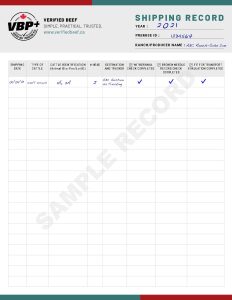
The VBP+ Shipping Record template is a single checklist that producers can go through when preparing a load of cattle for shipment. By filling out the document completely, producers can rest assured that they have done their part in ensuring high-quality animal care and food safety. Transportation and entry into the food chain are the points where consumers who are not connected to agriculture have the greatest chance to observe what producers do. So, it is important to make sure that what the public sees is Canadian beef producers’ commitment to these principles.

The top of the shipping record includes three important pieces of information. The year helps producers keep shipping records organized over time. Since the document has several rows, most producers can use only one or two of these sheets per year by recording all of their loads on one document. The premise ID is important for traceability purposes. In the event that an issue is discovered with an animal later on in the food chain, the Canadian Food Inspection Agency can use this record to trace the issue back to the premises of origin and prevent further hazards from entering the food chain. Finally, while the ranch/producer name might seem obvious to the recorder, this identification helps make this document useful proof of attention to the checks included in the record.

The next three columns help the producer associate the checks contained in the record with specific animals from their herd. The type of cattle column allows the producer to indicate the general class of cattle being shipped. This column is useful for quick reference when looking back on the record. For example, writing “weaned calves” in this column would help the producer remember that they had completed the shipping record when shipping their calves in the fall after weaning.

Similarly, the cattle identification column lets a producer narrow down which cattle they are referring to in the record. This specificity is important because it ensures that the three important checks in the last columns of the record are actually associated with the cattle being shipped. This identification can apply to single animals in the case of small loads or refer to groups of cattle using the producer’s own identification systems. The number of head allows for verification that the number of cattle that end up on the truck matches the number of cattle which were confirmed for safe shipment using the shipping record.

Recording the destination and trucker further aids in traceability in case an issue arises down the line. This column adds another pin on the map of where cattle move in their lifetime, helping officials track down the source of a problem should one come up. The trucker information is important for this same reason, as well as to have a record of the verification of a safe shipment before transferring care of the livestock from producer to trucker.

The final three columns are the “meat and potatoes” of the shipping record. These columns provide proof that a producer has done their due diligence in three key areas of responsible production. Firstly, indicating withdrawal check completed with a check mark shows that the producer has reviewed other records to confirm that the cattle in the shipment are not in a withdrawal period for an animal health product. While checking treatment records for the animals in the shipment is an obvious step, it is also important to think of other records linked to withdrawals, such as documentation of herbicide or pesticide usage. If animals grazed on pasture with a particular chemical, they may be subject to withdrawal for this reason as well. For cow-calf producers, it is important to note that animals may be shipped to a feedlot while still on withdrawal provided that their withdrawal information is sent to the feedlot operator along with them. This step will allow the feedlot operator to assume responsibility for ensuring that residues will not end up in carcasses.

The broken needle record check column is similar to the previous column in that it directs the producer to refer to a different document. The producer checks this box to indicate that they have reviewed records of broken needle occurrences on farm and confirmed that none of the animals in the shipment were involved in a broken needle incident. If cattle have broken needles, they should be retained for own consumption and the processor can be made aware of the location of the broken needle.

The final column verifies the fit for transport evaluation. This section requires the producer to observe the cattle in the shipment to verify that each individual can be safely transported without risk to animal welfare. In short, an animal is fit for transport if it can be expected to arrive at its destination in good condition. Lameness, injuries, and disease are all factors that can classify animals as either compromised, requiring transport with special provisions, or unfit for transport. Animals that are unfit for transport cannot be transported unless for veterinary diagnosis or care. The National Farm Animal Care Council (NFACC) Code of Practice for the Care and Handling of Beef Cattle contains a decision tree to help producers distinguish between these classes. This resource is also available within the Vulnerable, Distressed, and High-Risk Cattle section of the VBP+ Producer Reference Manual.

Shipping records are one of the key critical control points for producers to attend to in protecting food safety and animal care standards. This sample record, as well as a blank template for producer use, can be found under the Producer Resources section of our website.