SIMPLE.

PRACTICAL.

TRUSTED.

VBP+ BLOG & NEWS

January
How To Prepare for an On-Farm Assessment: VBP+ Pre-Certification Resources for Canadian Beef Producers

Are you a Canadian beef producer working toward VBP+ Certification for the first time or preparing for a renewal assessment? 

VBP+ wants to ensure you feel ready and have resources at your fingertips so your on-farm assessment can be completed more efficiently, in less time and with greater ease.

Start Here!

If you are considering certification, training is the place to start. VBP+ training explains the VBP+ Standard criteria and examines the records needed for an on-farm assessment.

Pre-Certification Consultation

Producers who participate in a pre-certification consultation with a VBP+ Coordinator or watch a pre-certification webinar prior to an on-farm assessment are consistently better prepared.

The pre-certification webinar includes valuable tips to ensure the on-farm assessment process is clear and simple. Watch the recording for key information:
•    How to get ready for an on-farm assessment
•    What to expect before the assessor visits your operation
•    Where will the assessor want to visit on your farm
•    Incentives available with your certification
•    CRSB Certification details
•    Q&A for unique operational systems and processes

What To Expect During an On-Farm Assessment

Let’s talk: On-farm assessments are designed to feel like a conversation between you and the assessor. VBP+ assessors are producers themselves and are experienced with cattle production in Canada.

Take a tour: During the farm walk-through, you can plan to show the assessor a variety of areas on your farm such as cattle, calving grounds, water sources, feeding areas, handling facilities, feed storage, pastures, medicated feed storage and equipment, minerals and supplements, non-ruminant feeds, chemical storage, lagoons or septic systems, animal health product storage and delivery equipment. What can’t be covered during the tour (due to remote location or weather) can be explained verbally.
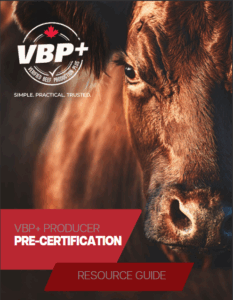
Show off your records: Your on-farm assessment will also include a discussion about critical records. Some certification criteria can be met through verbal descriptions, while others require that you show physical records in the way that works best for you. There is no mandatory record-keeping format, however VBP+ offers a selection of record-keeping templates if you choose to use them. At the completion of the assessment, the assessor will discuss any actions that may need to be taken on your operation to meet specific criteria and work with you to create a plan for corrections if needed.

What Will Be Assessed on My Operation?

To become VBP+ Certified, various criteria are assessed on-farm, providing a holistic view of production practices on the operation.

Animal Health: Examines how animal health products are used on your operation and how cattle health is managed. Criteria are based on the beef industry Hazard Analysis Critical Control Point (HACCP) plan to reduce risks of negative outcomes for cattle health or food safety.

Animal Nutrition: Assesses your operation’s process for ensuring cattle have adequate quantities and quality of feed and water. These criteria include how cattle condition is monitored, how medicated feed is managed and how contamination risks are avoided on the operation.

Animal Care: Examines your processes for cattle handling and shelter, management of painful procedures and animal stress as well as how cattle are regularly monitored on your operation. The requirements for this section are informed by the Code of Practice for the Care and Handling of Beef Cattle.

Vulnerable, Distressed and High-Risk Cattle: Criteria assess how cattle with a poor prognosis are managed on your operation. Specifically, this section covers euthanasia decision making, euthanasia processes and how operations manage deadstock.

Transportation: Examines practices when transporting cattle, including pre-transport checks to ensure cattle are free of withdrawals and physical hazards and are fit for transport, as well as demonstrating an understanding of transport regulations for compromised or unfit cattle and transfer of care documentation for cattle transferred to a new owner.

Biosecurity: Assesses on-farm practices to minimize the risks of disease spreading onto, off and within your operation, including management of animal movements, visitors, tools and equipment. This section also examines how operations work with their veterinarian to prevent and manage disease. This section is informed by the Canadian Beef Cattle Biosecurity Standard.

Environmental Stewardship: Examines how you work to reduce your operation’s impact on the environment, including management of water, air quality, soil nutrients and land resources. This section also examines processes for wildlife management and chemical inputs, as well as practices to prevent foreign objects from penetrating cattle hides on the operation.

Emergency Response and Preparedness: Evaluates your plans to manage disasters or emergencies on your operation. This section is intended to encourage producers to think about how to respond to an emergency before it happens, thereby minimizing damage and stress if an incident were to occur.

Training and Mentoring: Addresses the management of human resources on your operation. Even family operations without hired staff benefit from a plan to ensure a safe work environment and growth opportunities for people working on the farm.

Community and Leadership: Assesses how your operation interacts with the broader community and integrates new technologies and innovations. Innovation and community involvement can mean different things in different operations, so this standard is not meant to be prescriptive, but rather to recognize the efforts beef producers are making as leaders in their communities, the values of their operation and their efforts towards production efficiency.

How Do I Score?

Criteria are assessed with a scoring system from 0 to 3, reflecting the depth of implementation for a particular practice or process on the operation. The scoring system is generally based on the following continuum:

0 – No awareness or knowledge of the criteria

1 – Knowledge and verbal description of how your operation meets the criteria

2 – Records to prove implementation of the criteria along with a verbal description of the process

3 – Written protocol of process and records to prove implementation

Some criteria, called Critical Control Points (CCP), are criteria which require records. These criteria are mostly on-farm food safety criteria and are used to prove a commitment to producing safe and quality beef. CCPs are required criteria. A minimum score of two is required for these criteria. All other criteria are standard criteria. A minimum score of one is required for these criteria.

What Do I Have To Do for Renewal Assessments?

To maintain the rigor of the five-year assessment cycle, VBP+ performs an assessment of your operation every year. The cycle begins in year one with the on-farm assessment. Then, in years two through five of the assessment cycle, simple records assessments and self-declarations replace the on-farm assessment.

VBP+ is here to help!

VBP+ is committed to helping beef producers feel confident and prepared for their on-farm assessment. For more resources, producers are encouraged to contact their VBP+ provincial coordinator for more information or to explore these related resources:

Sustainability, Safety and Success through Verified Beef Training

This article was first published in the Fall 2025 issue (Vol. 2 No.3) of SaskCattle Times, and is reprinted on the VBP+ Blog with the publisher’s permission. To access the full digital issue of SaskCattle Times Magazine, click here.

Verified Beef Production Plus producer training, photo courtesy SaskCattle Times


In today’s competitive beef industry, maintaining high standards of quality, safety, and sustainability are more important than ever. For beef producers, taking the Verified Beef Training offers numerous benefits that can significantly enhance business operations and consumer confidence.

“Taking the time to complete the VBP+ training not only opens up SCAP funding for producers but it shows that they are willing to learn more about what best management practises they can implement to prove to consumers the food we produce is sustainable and safe,” said Joleen Shea, Vice Chair of the Saskatchewan Verified Beef Board and rancher from Kindersley.

This training not only equips producers with essential knowledge and skills but also demonstrates a commitment to excellence that resonates across the supply chain. One of the primary benefits of Verified Beef Training is the emphasis on food safety.

While we are all ranching and farming because we probably love working with animals and being outdoors, the training emphasizes that at the end of the day we are producing food for people to eat and our actions on-farm can have consequences on the end product. Emphasis on records keeping ensures everyone involved on the operation knows which animals have been treated and what the treatment dates and withdrawal dates are.

Tracy Hebert, Knowledge Mobilization and Communications Director with the Beef Cattle Research Council explains that the “VBP+ training helps producers and their employees minimize risk and provides opportunity for adopting beneficial practices and innovations.” The training delivers practical information, ideas, and tools that help producers strengthen their operations. It emphasizes better record-keeping practices to prevent problems such as double treatments, while also ensuring that if an operation is ever questioned, detailed records can demonstrate due diligence.

Producers also gain proper guidance on vaccine handling and injection techniques so the time and expense invested in herd health lead to the results they expect. By formalizing best practices, the training further enhances operational efficiency and supports long-term success.

The training provides producers with practical information, ideas, and tools that strengthen day-to-day operations. It encourages accurate record-keeping to prevent issues like double treatments and ensures that, if questions ever arise, detailed records demonstrate due diligence. Participants also learn proper vaccine handling and injection techniques so that the time and money invested in herd health achieve the intended results. In addition, by formalizing best practices, the training helps producers improve efficiency across their operations.

The training also strengthens the industry’s reputation and reassures customers about the high quality of Canadian cattle and beef. It does this by providing guidance on reducing disease, minimizing carcass defects, and promoting best practices in areas of public concern such as painful procedures, livestock transportation, and grassland management.

Producers who complete the VBP+ training demonstrate that they are proactive in caring for animals, the land, and the food supply chain. It provides producers confidence that plans are in place for emergency  response, and that practices done on farm are in line with national standards.”

“At times the industry is focused on reporting only how many operations are VBP+ Certified (completed the on farm assessment), but I think the bigger story is how many people and operations the VBP+ program is impacting by completing the training,” explained Karla Hicks, Chair of Saskatchewan Verified Beef Production Board and rancher from Mortlach.

“The training provides new and different ideas that you can implement on your operation like adding additional information to your treatment records, having protocol around needle disposal, vaccine storage and correct temperatures that don’t include the dashboard of the truck! Biosecurity is another big topic that is covered in the training. It is not meant to tell people how to manage their operation, but provide awareness of areas to improve upon to prevent a disease outbreak.

“For example, if you invite a neighbour or client to come and walk through a pen of calves or tour your cow herd, the biosecurity component of the training will help you think a little differently about the visit and provide practical suggestions on how you can still tour your cattle, but simultaneously having protocol in place to prevent a disease outbreak. These practices aren’t meant to complicate anyone’s operation, only enhance what you are already doing. The training component of VBP+ is invaluable and I don’t think we give enough weight to the outreach and impact it’s having.”

If you are interested in taking the training, it is available online anytime at www.verifiedbeef.ca, or you can contact your local VBP+ coordinator to set up an in-person training workshop in your area.

Understanding the VBP+ On-Farm Assessment

This article was first published in Volume 5 Issue 2 of ABP Magazine (May 2025), and is reprinted on the VBP+ Blog with the publisher’s permission. To access the full digital issue of ABP Magazine, click here.

When a producer decides to get certified with the Verified Beef Production Plus (VBP+) Program, they go through an on-farm assessment to confirm that they are meeting the requirements of the VBP+ standard. This process can sound intimidating but is really designed to help producers succeed and make the most of their certification.

What is the VBP+ on-farm assessment?

The on-farm assessment (previously known as audit) consists of a visit to the farm by a third-party assessor. When an assessor comes to the farm, they will walk through the key areas of the farm with you, including cattle pens, processing areas, feed and medication storage, and calving facilities. The assessor will also look over the key records that producers keep as part of the VBP+ program, making sure that they include all of the required components for the program.

The assessment is meant to feel conversational. Assessors are there to understand how your operation works and listen to the expert on your farm—you!

“For many producers, the VBP+ on-farm assessment feels like touring a neighbour through the farm,” says Shannon Argent, VBP+ business manager and a VBP+ Certified producer. “The process is designed to celebrate all of the successful practices and tools producers have implemented and identify areas where risks could be reduced.”

Dan Skeels of Anchor D Simmentals & Charolais completed an on-farm assessment last fall. “Our assessor was very complimentary about what we do,” says Dan. “He was great and really helpful.”

When an assessor is assigned to your farm, they will reach out to you to arrange a time for the assessment that works for you. They will also confirm any biosecurity protocols that you may have for visitors coming to your operation to make sure they are respecting the way your operation runs.

What happens after an on-farm assessment?

After the assessor visits the farm, they will complete a report of their findings. The results of the report are kept between the VBP+ program and the producer, and are intended to help the producer identify the areas they are excelling in and places they may want to dive further into to improve.

“The on-farm assessment is not a pass or fail evaluation,” says Shannon. “If an assessor identifies an area where the operation is not meeting a requirement of the VBP+ standard, they will issue what is called a corrective action request (CAR). The assessor will explain the areas where a producer may need to adjust their record-keeping or practices to meet the program requirements, and the producer will be given time to implement those changes.”

After the assessor visits the farm, they will complete a report of their findings. The results of the report are kept between the VBP+ program and the producer, and are intended to help the producer identify the areas they are excelling in and places they may want to dive further into to improve.

Learn more about the assessment in the VBP+ Producer Reference Manual Self-Assessment Field Guide.

“The on-farm assessment is not a pass or fail evaluation,” says Shannon. “If an assessor identifies an area where the operation is not meeting a requirement of the VBP+ standard, they will issue what is called a corrective action request (CAR). The assessor will explain the areas where a producer may need to adjust their record-keeping or practices to meet the program requirements, and the producer will be given time to implement those changes.”

The program is not designed to be prescriptive and allows producers to design their own processes and management practices to meet the program. A good example of this approach is treatment records. While VBP+ offers templates that include all of the required information, producers are not required to use these templates. If your notebook, spreadsheet, iPhone, or herd management software are working well for you, there is no need to reinvent the wheel. The assessor will work to understand your systems, not impose one upon you.

“The program to us is common sense,” says Dan. “If you’re new to the program, I would say there’s no need to overthink it. It’s probably what you practice everyday. It’s important that our industry is transparent and that we are able to show people what we do everyday for a living.”

Who are the assessors?

The assessor assigned to your operation is there to help you succeed. While they cannot provide coaching or help you implement the VBP+ standard, they are more than willing to answer questions about the requirements of the program. Assessor Deborah Armstrong and her husband were among the first group of ranchers certified with the Verified Beef Program on their cow/calf operation. “I commend the fact that the VBP+ program is built by producers for producers,” says Deborah. “Assessors, as ranchers themselves, have a sound knowledge of the industry and understand the practical aspects of everyday ranching. For me, being an assessor is an important way to recognize the hard work and commitment of producers.”

“Many of our on-farm assessors are producers themselves,” says Shannon. “They are there to help fellow producers and their operations succeed.”

How do I get certified?

Producers who are interested in completing an on-farm assessment to pursue VBP+ Certification can contact VBP+ Delivery Services Inc. to submit an application. Find contact information and more details on the certification process on verifiedbeef.ca under the Certification tab.

Attend the Free VBP+ Webinar: Getting Ready for Your On-Farm Assessment
VBP+ pre-certification webinar: Getting Ready for Your On-Farm Assessment

Whether you’re pursuing your first VBP+ or CRSB certification or preparing for renewal, this webinar is for you! 

Registration is now open for the Verified Beef Production Plus (VBP+) “Getting Ready for Your On-Farm Assessment” webinar. After participating in this webinar, the on-farm assessment will be more efficient, taking less time and with greater ease as you will be well-prepared for assessment questions.   

This webinar will dig into the assessment process and the records required for assessment. With the understanding that every operation is different and utilizes unique systems and processes, this webinar provides the opportunity to address specific questions related to your operation.  

What You Can Expect from This Webinar

This webinar is being offered on two separate nights to accommodate producers across Canada in differing time zones. The webinar presentation will be the same on each night.  

Choose the session that works best for you! 

Eastern Time Zone: 

Monday, December 1, 7:00 pm Eastern Time  

4:00 pm BC | 5:00 pm AB | 6:00 pm SK & MB

7:00 pm ON & QC | 8:00 pm NS, NB & PEI 

Western Time Zone: 

 Tuesday, December 2, 7:00 pm Mountain Time 

6:00 pm BC | 7:00 pm AB | 8:00 pm SK & MB

9:00 pm ON & QC | 10:00 pm NS, NB & PEI 

Pre-Certification Tips to Help You Prepare

Producers who participate in a pre-certification consultation prior to the VBP+ on-farm assessment are consistently better prepared. The purpose of this webinar is to provide this pre-consultation in an easy-to-access format with flexibility to meet your schedule.  

Live Questions & Answers with VBP+ Staff

This webinar will provide a live Q&A session, providing you with the opportunity to ask questions specific to your own operation and with specific reference to any area of the on-farm assessment you may be unsure about. This webinar is ideal for producers who are considering certification or have submitted their application and are awaiting assessment! 

Can’t make the live session? No problem—all registrants will receive the recording. 

Managing Hunting Season Risks on Beef Cattle Operations

Canada ushers in the fall season with beautiful colors, cooling weather, reduced daylight hours, migrating birds, mating ungulates like deer and elk, and scavenging bears. Depending on conditions in your region, cattle are often still out on pasture, on hay fields, swath or bale grazing or utilizing cereal crop residues.

Fall also coincides with hunting season. Producers can maintain the balance of biodiversity and wildlife conflict through managed and controlled hunting access. While managing access to your property by hunters, it is important to ensure these hunters are respectful of the presence of cattle on your operation to reduce the risk of unintended foreign materials in beef carcasses.

The potential of birdshot and buckshot in beef carcasses is an ongoing concern. As a landowner and/or manager of cattle, it is important that prevention and risk reduction remain a priority.

How to protect cattle and consumer trust by mitigating the risk of birdshot and buckshot in beef carcasses:
  • Post “No Hunting” or “No Trespassing” signs on your property so only hunters with permission, and who have been informed of where cattle are located, hunt on your property.
  • Inform hunters of your operation’s commitment to reducing the risk of foreign material contamination in carcasses and confirm their commitment to responsible hunting practices.
  • Ensure that pastures and fields where cattle are grazing or feeding have good fencing to prevent cattle from straying into property where hunters are not aware of their presence.
Livestock on pasture, No hunting without permission, no trespassing VBP+ sign
Need signage for hunting season? VBP + has you covered! Note: Shipping is temporarily paused due to the postal strike, but will resume once the strike is resolved.
How to reduce risk when using firearms:
  • Consider zone of fire when using firearms to deter predators (e.g., coyotes, birds) near herds, feedlots or silage pits.
  • Don’t use shotguns for loud sounds to help move difficult cattle from bush areas.
  • Support training for new firearm users on the operation.
  • Treat every shot as having the potential to travel and spread.
  • Consider zone of fire and the right tool for the right job when performing necessary euthanasia.

Birdshot and buckshot contamination of beef carcasses can be a problem caused by irresponsible hunting or handling practices, so it is worth the effort to prevent these production-limiting, costly physical hazards that threaten consumer trust.

Facebook
LinkedIn
X
Threads
Follow These Steps to Make the Most of CRSB Certification

This post was developed in collaboration with the Canadian Roundtable for Sustainable Beef (CRSB) and summarizes information found on the CRSB Certified website.

Operations certified under Verified Beef Production Plus (VBP+) are also Canadian Roundtable for Sustainable Beef (CRSB) Certified. We encourage all producers to take full advantage of the benefits offered by both certifications. Read below to review the requirements that enable you to maximize the value of your CRSB Certification.

One Missed Step Is Value Lost

As a CRSB Certified operation, you have the opportunity to participate in certified supply chains, and you could be eligible for incentives like Cargill Qualifying Cattle Credits which reward producers for providing cattle that move through Certified operations from birth up to and including the primary processor at Cargill.

To be considered an active CRSB Certified operation, and for cattle to qualify for certified supply chains, know the following steps are required:

  1. Maintain certification through a CRSB-approved certification body (like VBP+)
  2. Consent to sharing your operation’s information with CCIA for chain of custody purpose
  3. Submit birth dates to the Canadian Livestock Tracking System (CLTS) for animals born and tagged on your operations
  4. Submit move-in events to the CLTS every time cattle move to a new operation

Consent to Sharing Your Operation’s Information with CCIA

Log in to your Canadian Livestock Tracking System account and double-check that it shows “CRSB Client Information” under My Account. 

  • If this section does not appear, it means that you have not consented to sharing, the CLTS won’t see you as an active CRSB Certified operation, and your calves won’t have a chance to qualify for supply chains or qualifying cattle credits.
  • The only information that will be shared with CCIA for chain of custody purposes is your operation name, email, mailing address, CLTS account ID, certification date, audit type, and a certification status change / de-certification date.

To update your settings, contact VBP+ (info@verifiedbeef.ca or call 587-328-5980) and request your consent be added to your account.

CRSB Certified – Maximizing Value for Cow-Calf Producers

As a cow-calf producer, you start the chain, so it is important that you enter your calf birth dates in CLTS.
Birth dates (or birth date range) provide a data starting point for that tag and animal in the CLTS (CRSB Certified supply chain) system.

• Whether you market your calves through an auction market, online marketing platform or a direct marketing group, share your certificate number and make it known that you would like any descriptions of your calves to include your CRSB and VBP+ Certification and that your birth dates have been submitted.
• If you sell directly, let them know you are CRSB and VBP+ Certified and that birth dates (individual or range) for your calves have been submitted to the CLTS.
• Sell to a Certified feedlot or backgrounder where possible, and encourage them to do a move-in event in the CLTS to keep the chain going and keep you both eligible for incentives!
• Current operations certified by VBP+ can be visually validated through the VBP+ Online Producer Sales Listing.
• Ontario feedlots certified by Ontario Corn Fed Beef program are also listed here.

As a Certified feedlot or backgrounder, look for cattle from certified operations. Let your cattle buyers and auction markets that you deal with know you are certified and actively looking for certified calves to buy. Ask your cattle suppliers if they are certified and check that they have consented to sharing information and their birth dates (individual or range) have been submitted to start the chain. 

Buying calves this fall? Submit move-in events to the CLTS every time cattle move to a new operation.

Make sure you submit move-in events in your CLTS account for all cattle that move into your operation. This keeps the chain of custody going to show that animals have come from Certified operations from birth to processing. 

  • If you know the cow-calf operation that cattle came from, contact them to encourage sharing their operation information and submitted birth dates in the CLTS.

Using the CRSB Certification Search Tool

The CRSB collaborated with CCIA to integrate a CRSB Certification Status tool in the CLST/indicator number to view the CRSB Certified status of an animal’s CRSB Certified status by tag/indicator number. Use this tool to verify CRSB Certified status of purchased animals.

Check out the CRSB Certified factsheet, FAQ and June webinar for more.

For help with any of the steps described in this article, contact the CRSB:

You can contact the Client Support Team at CCIA for assistance with submitting data on CLTS at 1-877909-2333 or info@canadaid.ca.

Contact the CRSB if you have any CRSB Certified program questions.
Info@crsbcertified.ca

Facebook
X
LinkedIn
Threads
Getting Ready for Branding
beef producer filling syringe
Having one person responsible for managing vaccines (mixing, filling syringes, monitoring temperatures in coolers) or other medications can increase efficiency and ensure good management practices to prevent cross contamination of vaccines and recommended needle changes in the branding pen. Photo credit: VBP+

The days are getting longer, the seasons are shifting, spring is on the way! On your beef cattle operation, the task of the season is changing too. Transitioning from calving season through seedstock sale season, spring means branding season is just around the corner.

The branding pen can be chaotic, with lots happening at once. A little preparation ahead of time can go a long way. The first step is determining what your spring processing protocol for young calves will be. If you have already had a discussion with your veterinarian about your annual herd health protocols, such as spring calf processing, you will likely have many of these answers. Not all operations are alike but here are some protocols to discuss with your veterinarian; vaccine protocol, pain mitigation protocols and implant protocols (if it applies to your operation). VBP+ has a herd health protocol template you can take to your veterinarian if one is not provided. You can find it here.

Once you have your product requirements, you can plan for the equipment needed  such as syringes, needles, sharps containers and animal markers to name a few Is the equipment you need clean and in good working order? Are your multi-dose syringes calibrated? Now is a good time to check. A malfunctioning syringe that dispenses either too much product can cost you money and run you short of vaccine. It’s a good practice to give your syringes a spring cleaning using only hot water. Never use any detergent/soap to clean syringes, as any residue can affect your vaccine. Also remember never to use a syringe that was used for antibiotics as your vaccine gun – when possible, label and use designated syringes for vaccines.

Planning for your people resources is important too. Depending on what your spring processing/branding protocol is, there will likely be multiple people descending on each calf either on the ground or in the table, many of them friends or family that help out once a year. Are they aware of any biosecurity concerns or protocols on your operation? Do they need a refresher on how to give sub-cutaneous and intramuscular injections properly and safely? A reminder on how to move around the pen to keep themselves, others and animals safe? Who do they go to if they have questions or if something goes wrong?

Create open communication with your volunteer crew about possible deviations that could occur during branding (ex. animal moved and missed giving the full injection, calf was let go before injection was given). The last thing you want is someone to make a mistake (for example, breaking a needle in an animal or double vaccinating) and you don’t know about it. A quick meeting or training session before the big event can help you to make sure everyone involved knows your operation’s on-farm food safety, biosecurity or animal care objectives and values.

Keep your individual and group treatment records handy to include any treatments and vaccinations done on branding day. It’s also a good idea to keep extra RFID tags around in case you find a calf that has lost one.

Sometimes, calves can have adverse reactions to vaccines. Keep yourself prepared with epinephrine on hand. You can also prepare yourself for other accidents or emergencies by keeping a first aid kit handy and having a plan to extinguish a fire around the branding pot.

Brandings are a good way to get many spring tasks knocked off the list prior to pasture turnouts and indulge in a little social connection with family and friends. Plan for a successful and safe branding day. You, your operation and your livestock will be the better for it.

Planning for Re-certification
agriculture management with VBP+ online tools
Planning for re-certification can make the experience smooth and convenient. Photo credit: VBP+ stock photo.

What happens at the end of the five-year certification cycle? What can I do, as a producer, to ensure my certification (s) remains active while we work through the logistics of re-certification? These are questions we get often, so we will walk you through the process.

When your operation has completed the initial on-farm assessment and your certifications (VBP+ and CRSB) become active, the date of that initial on-farm assessment becomes your Anniversary Date. Your certification events, records assessments and self-declarations, next on-farm assessment and notifications around these events are based on that Anniversary Date. That Anniversary Date is also an important guideline to maintaining an active certification. Your certification is active from the one Anniversary Date to twelve months after, or the Anniversary date of the following year.

VBP+ Delivery Services Inc. (VBP+ Inc.) sends notifications of the annual re-certification events (records assessments, self-declarations and the next on-farm assessment starting three months prior to the Anniversary Date. This is done to ensure that you, the producer has everything they need to complete the requirements prior to or by the Anniversary date, maintaining your active certification. When you have completed the requirements and receive your active certificate, you will also be informed of what your next event will be and what your Anniversary Date is. For example, when you complete the Year 5 Self-Declaration, you will receive your active certificate and your assessment report. The report will include a summary of the assessment, any corrective actions assessed, what your next assessment event will be and when it is due.

When you receive that Year 5 assessment report and active certificate, there are a few things you can be thinking about prior to your next on-farm assessment.

  • Are you going to renew your certification? There are benefits to maintaining your certification, you can check them out here.
  • Is your Anniversary Date working for you and your operation? If your initial on-farm assessment occurred during a time that is inconvenient, we can adjust to a time prior to that Anniversary date (this is important) that is more convenient.
  • Does your operation need some pre-certification support? Your provincial coordinator is more than happy to walk through the certification process and requirements with your operation prior to your assessment.
  • Coordinating the logistics of the re-certification process, application, payment, assigning an assessor, finding a time that works for both your operation and the assessor can be a time-consuming process. Don’t leave any of these steps to the last minute, communicating with our certification coordinator early, at least three months prior to your Anniversary Date can help ensure the re-certification process is smooth and convenient for your operation and avoid disruption to the active status of your certification.

Renewing your certification doesn’t have to be stressful or inconvenient. VBP+ and VBP+ Inc. can help with any questions you might have or have a look through our resources to see if there are any that might enhance your records or help your operation speak to their practices, processes or values. Check them out at www.verifiedbeef.ca.

Safe Salvage: Making Sure Your Salvaged Feed is Right for Your Cows
barley crop

In many parts of western Canada this year, rain came early and made for a solid grass year. Unfortunately, the rest of the summer brought mostly extreme heat with little moisture other than a handful of storms that brought extreme wind and hail with them. This has left many grain farmers looking to salvage their damaged crops by repurposing them into livestock feed. 

Cattle are the ideal up-cycler for products that aren’t suitable for human consumption, but there are a few factors to take into consideration to make sure that salvage is successful.

sprayer in crop of wheat

Chemical Withdrawal Times

When farmers are planning on using a crop to produce grain, whether for human or livestock consumption, they use different pesticides than they would if they planned for livestock to graze the crop standing. Each product has a label that indicates restrictions, warnings, and guidance on using crops for livestock feed. Reading and following the label will prevent any harm to livestock when salvaging these crops, and also prevent any chemical residues from ending up in carcasses.

Every product is different in terms of its restrictions for livestock feed, but a couple examples of guidelines you might encounter are:

For more tips on following chemical withdrawal times, check out our Salvaged Feed Fact Sheet:

aerial view of swaths

Feed Testing

If a crop is up for salvage, it’s probably been damaged in some way, which also has impacts on the nutritional composition of the crop. Feed testing is important to make sure that the nutrients (energy, protein, etc.) in the crop can be fit into a whole ration to get cattle what they need, but also to make sure there’s nothing potentially concerning in the feed.

A common concern in salvaged feed during a drought is high levels of nitrates and sulphates. While not necessarily toxic on their own, high nitrate or sulphate levels in feed can compound higher levels in other feed ingredients or even water. Feed testing lets you understand what you’re working with so that you can work in salvaged feed without causing unintended harm.

For more tips on alternative feed sources and testing feed, check out the Beef Cattle Research Council’s Alternative Feeds page:

aerial shot of combining and hay bales

Setting a Price

For a mixed farm, it’s easy enough to take a salvaged crop from one enterprise and feed it to livestock in another. But what about grain farmers who might be looking for a neighbour with cattle that could use some feed?

It can be hard to figure out how to put a price on salvaged feed – after all, it’s not a typical avenue for marketing, hence the term salvage! Luckily, the Beef Cattle Research Council has a calculator to help put a value on salvaged crops:

Shop Verified Beef with Our New Web Store

VBP+ is excited to announce the launch of Shop Verified Beef – a web store for the Canadian beef producer! 

Our team is committed to offering value to producers, and we’ve come up with a suite of items that we feel will do just that.

The web store will offer items in two main categories:

VBP+ roping gloves, toque and cap

VBP+ Swag items are wearables or usable items that let producers rep the VBP+ brand! Swag items are priced according to the cost to ship the item.

VBP+ biosecurity sign, gate sign, magnet thermometer, cooler bag, sharps container, all weather pen

Tools for the Farm includes items that are useful for beef producers, whether certified or not. This includes items like sharps containers and cooler bags that help producers use animal health products safely and effectively, but also includes signage like farm biosecurity signs or additional Certified Operation signs for producers with multiple sites. 

Tools for the Farm are also priced according to shipping, but many of the small items are free of charge to allow producers easy access to tools that can help them out, particularly if they are involved in the VBP+ program.

pocket calving record book from VBP+ and BCRC

Under the Tools for the Farm category, you’ll also find access to order the VBP+ Pocket Calving/Record Book! If you’re looking to order 1-4 books, you can place an order free of charge using the option pictured above on the left. For larger quantities, you can order books in packages of 5 to cover shipping costs of larger numbers.

We’re always looking for new ideas for items that would be of use to Canadian beef producers. Items in the works for the future include:

  • Printed VBP+ resources, like record templates and manuals
  • Cowboy briefcases (hold animal health materials on a fence board)
  • Treatment thermometers
  • And more…
Got suggestions for new items? Drop your ideas in the message box below!