
SIMPLE.

PRACTICAL.

TRUSTED.

VBP+ BLOG & NEWS

abandoned farmstead in winter

Foreign objects can present a food safety issue for consumers who purchase meat products from affected animals later on down the supply chain, and can also impact animal health and welfare prior to slaughter. Luckily, foreign objects are a risk which producers can mitigate on-farm.

In most cases, foreign objects enter animal carcasses in one of two ways. Cattle can either consume them, or they can penetrate the hide and end up lodging within tissues.
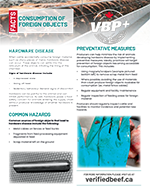
Consumption of foreign objects fact sheet

When cattle consume foreign objects, the material usually gets caught in the reticulum, where it can irritate the tissue within this chamber and cause pain for the animal. At this stage, cattle present a condition called hardware disease, which causes them to perform poorly and show general signs of discomfort such as a depressed state, poor appetite, and sedentary behavior.

Unfortunately, there are many common foreign objects found on-farm which cattle can easily consume. For example, metal cables on fences or feed bunks can be chewed and break if poorly maintained. Alternatively, fragments of metal or other material left on the ground or deposited in feed from processing equipment are easily consumed by cattle.

The best way for producers to prevent the risk of hardware disease, and its associated food safety concern, is to prevent access to foreign objects. If the operation processes feed, magnets or scalpers can be used to remove scrap metal from feed before it is offered to cattle. Where possible, producers should avoid using materials that could easily produce hardware, such as metal fence cables. If this is not possible, producers should regularly maintain equipment and facilities to avoid fragments becoming accessible to animals. Finally, regular inspection of feeding areas for foreign objects and monitoring of cattle and facilities for incidence and new hazards is key.

In other cases, cattle do not eat the foreign object, but rather rub against one such that it penetrates their hide. If these foreign objects become lodged in muscle and the producer is not aware, meat containing these foreign objects can enter the food chain and lead to consumer distrust and potential injury. In some cases, recalls or refusals of carcasses or portions of a carcass at processing plants may occur.

Sources of foreign objects that can penetrate cattle hides are relatively similar to those that can cause hardware disease. Scrap metal, derelict buildings, and poorly maintained equipment are easy for cattle to rub against and pick up metal fragments. However, a few common sources are unique to this route of entry. Buckshot or other shrapnel in areas where birds are hunted can enter the animal. Alternatively, metal or hard plastic rollers used for cattle to scratch can deposit small fragments in the hide.
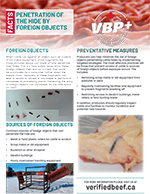
VBP+ penetration of the hide by foreign objects

Much like the hazards, the solutions to foreign objects entering animal hides are very similar to those that prevent the consumption of foreign objects. Removing scrap metal and old equipment and restricting access to derelict buildings, metal or hard plastic rollers, or bird hunting areas will aid in preventing access to fragments that could enter the hide. Regular maintenance of equipment and facilities will also reduce risk. Finally, while preventive measures should be emphasized, producers should monitor and document incidence in cattle to avoid entry of foreign objects into the food supply chain.

Regardless of the route of entry, handling foreign objects with cattle relies on the same basic principle: producers should prioritize prevention and maintain good maintenance and inspection to avoid food safety hazards entering the food supply chain.

To brush up on foreign objects, check out VBP+’s two fact sheets on Consumption of Foreign Objects and Penetration of the Hide by Foreign Objects.
The next new section of the VBP+ Producer Reference Manual is out! This manual is a one-stop shop for producers to find certification requirements, sample records, self-assessment tools, and answers to a variety of questions about beef cattle management. With a fresh new look, be sure to check out the newly released Animal Nutrition section to refresh your memory on responsibly feeding your cattle!

The Animal Nutrition section is divided into three parts: General Feeding Practices, Forage Production & Pasture Management, and Medicated Feed & Water Practices. Each section, just like for the Animal Health section, includes checklists, self-assessment boxes, and images to learn and help you track your progress towards VBP+ certification.

General Feeding Practices first covers the most basic needs for animals by describing how to ensure that quality and quantity requirements for feed and water are met. Also note that at the beginning of this section, resources from the Beef Cattle Research Council (BCRC) are provided to help evaluate feeds based on nutritional value and cost. Finally, the General Feeding Practices sub-section finishes off by outlining considerations for non-ruminant feed used on farm, other feed ingredients including banned and unconventional feeds, and bedding materials.

As producers know, beef cattle nutrition relies heavily upon forages. The Forage Production & Pasture Management portion of the VBP+ Producer Reference Manual helps producers understand how to make the best use of their forages for their cattle. This includes awareness of toxic and invasive plant species, safe use of crop protection products like herbicides and pesticides, and responsible fertilizer use. Importantly, this sub-section helps producers reap maximum benefit from their forages without sacrificing food safety or animal performance and wellbeing.

Finally, the Medicated Feed & Water Practices sub-section helps producers who add medications to feed or water maximize their utility without sacrificing responsible use. This sub-section covers handling and storage of these medications, responsible dispensing of medicated feed and water, and proper protocols for cleaning associated equipment to maintain on-farm food safety.

Be sure to check out the Animal Nutrition section of the VBP+ Producer Reference Manual and stay tuned for new releases of additional sections!

For producers starting out with the VBP+ program, there are a variety of resources to assist with training and continuous learning, each with their unique uses. While the online training modules offer producers an interactive and streamlined process for learning, the VBP+ Producer Manual is a great resource for producers to use continuously for quick reference and to review important program concepts.

VBP+ has been undertaking an exciting redesign of the Producer Manual. In the new version, you will see a refreshing new look and additional tools to help producers best immerse themselves in the VBP+ program. To launch this new manual, VBP+ will be releasing one section at a time, beginning with the Animal Health portion.

The Animal Health section covers four subcategories: Records, Products & Equipment, Delivery Methods, and Inspection & Monitoring. Each section provides the producer with information on best practices, as well as details specific requirements to obtain VBP+ certification.

For example, the Records portion explains the purpose and utility of each required Animal Health record, as well as lists the information needed in each. This section will help producers streamline the records system they already employ to ensure they include necessary data. Sample records at the end of the section can also offer producers an idea for how to format their own records if they are unsure, with blank record templates available on verifiedbeef.ca.

The Products & Equipment sub-section explains best practices for handling and storing animal health products and maintaining related equipment. This section is a great reminder of the considerations needed to ensure optimum performance of animal health products and equipment, in turn supporting better animal productivity.

Similarly, Delivery Methods offers an account of proper procedure for delivering animal health products via different routes. Again, this portion will help producers ensure the success of their herd health protocol in fostering animal performance.

Finally, Inspection & Monitoring helps the producer connect their daily practices in observing their cattle to their herd health protocol by exploring specific points to check in on. Pictures and tables help illustrate examples to enhance understanding of concepts such as body condition scoring.

Key features like checklists of required information or practices are what make this new Producer Manual such a valuable tool for new trainees and VBP+ veterans alike. As the program evolves with the industry, the Producer Manual provides an up-to-date source to confirm all requirements for certification. Best of all, the new Producer Manual includes self-assessment boxes that align with audit questions to help producers directly evaluate their progress before an audit, with clear designations of the minimum scoring needed in each category. In addition,  sample records are provided at the end of the section to help producers visualize the certification requirements and recognize the elements they already use in their own record-keeping system.

In essence, the VBP+ Producer Manual is a one-stop shop for producers to find audit requirements, self-assessment tools, sample records, and program curriculum in an engaging quick-reference format. Particularly with the self-assessment boxes, this resource will allow producers to compare their operation with certification standards in preparation for an audit to help ensure success. The Producer Manual is also a great option for trainees who prefer learning from a print format, and the new style of the manual will enhance this learning experience.

Of all the tools in the toolbox available to the Canadian beef producer, the Compendium of Veterinary Products, specifically, the Canadian Edition, is an important one. This resource is available online through the VBP+ website as an icon on the home page under Featured Resources, and lists all veterinary health products approved for use in Canada.

When producers use any animal health product for prevention or intervention of disease in beef cattle, there is some important information that is needed for on-farm food safety and responsible antibiotic usage. The Compendium is a useful quick-reference tool for producers to help ensure these standards are maintained.

After entering the online tool, the site is divided into several tabs across the top. The first tab, Products, lists all veterinary products approved for use in Canada alphabetically according to their brand name. Icons beside product names indicate special classifications, such as Prescription  Drug or Medically Important Antimicrobial. Clicking on the name of the product will reveal more information about each one.

After choosing a specific product from the list, users can select one of two tabs from the top of the page: Label or Use/Dose. Most producers will benefit from using the Use/Dose tab, which provides a short list of the most commonly needed information about the product. For producers, some key points from this tab are the uses of the product, its route of administration, dosage, and withdrawal time. These key facts are both a component of required VBP+ treatment records and generally important to maintaining on-farm food safety.

The Label tab shows a more extensive description of the product and its associated considerations, much like what a producer could find on the paper insert that comes inside a product box. For a producer using this tab, a few key sections are especially relevant. The name and description of the product appear first, and help the producer identify the product. The Indications section lists the conditions for which the drug is approved for use in treatment. This is important for producers, since off-label drug use requires a specific veterinary prescription. The Dosage and Administration directions will help the producer understand how to use the product on their animals. Cautions and Warnings will provide important considerations for the producer to avoid unintended consequences and maintain food safety. Specifically, the withdrawal times for products are contained in the Warnings section. Finally, the Storage information offers key directions to help maintain the effectiveness of the product.

Along the very top of the page, producers can also access different tabs to search for products by other characteristics. The Companies, Categories, Uses, and Ingredients tabs categorize products by the company that sells them, the type of product (ex. local anesthetic), the type of condition that the product could be used to treat, or ingredients in the product. These tabs can be useful for a producer who wants to compare similar products. Finally, the Information tab at the top of the site has links to other documents regarding specific relevant topics.

The Charts tab at the top of the Compendium site can be a very useful starting point for producers using the tool. Specifically, the Withdrawal Time Chart for Beef Cattle offers an alphabetical list of all veterinary products approved for use in Canada with key details pulled out into a convenient table format. For each product, the withdrawal times and route of administration are listed directly beside the product name, with key notes below select products. Producers can also click on the name of a product to access its label and further information about it.

The Compendium of Veterinary Products is a useful tool for a producer who requires quick access to information that allows them to maintain on-farm food safety and use health products responsibly. It should be noted that the VBP+ website contains a link to the Canadian Edition, so the site only lists products approved for use in Canada. Certain information and product inclusions will differ between countries. For quick access out in the field, also check out the Compendium mobile app.

Canadian beef

Beef is the preferred protein choice for many consumers across Canada. A unexpected positive for many beef producers due to the COVID -19 pandemic is the outreach from consumers to support home-grown and local beef programs. As prevalent on social media, interest in buying local food direct from producers has blossomed and gained momentum. Loyal beef customers don’t question the quality and safety of eating beef but some folks do have concerns about environmental impacts of beef production and animal welfare issues. As a beef producer, there much you can do to assure your customer that your operation is doing everything right in the interest of the consumer and the animals by becoming trained and certified with the VBP+ program.

VBP+ training covers all 5 pillars of sustainable Beef Production; on-farm food safety, environmental stewardship, animal care, biosecurity, and human resources/community involvement. Taking VBP+ training and becoming certified through an audit is proof you can use to show your customers all aspects of beef production on your farm meets industry standards via third party verification.

VBP+ certification adds value to your unique brand and supports the good practices that you’ve put in place to differentiate your beef product (grass-fed, breed-brand, etc.) Investing in your own product is a huge commitment and VBP+ certification can provide protection of that investment through industry recognized, records and management practice verification and audit.

As a direct-to-market producer, there are many different ways to communicate to your customer about what a VBP+ certification means. VBP+ is has developed a direct to market toolkit to help producers how to effectively communicate about their certification and how to correctly use the VBP+ logo.

You can find the VBP+ Direct Marketer Toolkit and more producer resources at our website: www.verifiedbeef.ca

Click here to download the VBP+ Direct Marketer Toolkit