SIMPLE.

PRACTICAL.

TRUSTED.

VBP+ BLOG & NEWS

Last year, Farm Credit Canada (FCC) launched an initiative to recognize the efforts of producers certified with the Canadian Roundtable for Sustainable Beef (CRSB).  On May 2, 2023, applications for the program will reopen!

FCC will provide a payment to FCC customers who are CRSB certified through one of the CRSB’s certification bodies, including VBP+. So, VBP+ certified producers can take advantage of this opportunity.

“FCC is happy to be reopening applications for our sustainability programs. We are in a unique position to work with individual sectors in the agriculture and food industry on their sustainability goals,” explains Curtis Grainger, FCC’s director of sustainability programs. “The progress we’re seeing looks different depending on the sector and on an individual’s operation. That’s why the established, verified initiatives at CRSB and McCain Foods are important partnerships that allow us to support producers with their individual needs.”

Producers can receive up to $2,000, calculated as a portion of your lending with FCC, excluding operating credit. Producers can reapply annually.

“VBP+ appreciates FCC’s investment in certified producers through their Sustainability Incentive Program,” says Shannon Argent, VBP+ Business Manager. “Financially incentivizing producers who take the time and effort to participate in certification shows the commitment shared by both producers and stakeholders to advancing sustainability in the Canadian beef industry.”

If you are already certified, you can apply through the FCC page here. You will need to provide the following:

  • Contact information
  • FCC customer number
  • Certification body used (i.e. VBP+ if you are certified with us)
  • Copy of certificate

Note that you must be an FCC customer in good standing with an amount owing on current lending, and your CRSB certification must be current.

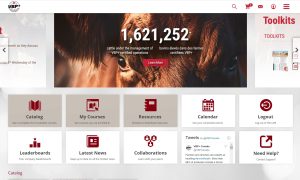
If you aren’t yet certified but want to join the program to be eligible, contact your VBP+ provincial coordinator using the info here to learn more. The provincial coordinator can set you up with an in-person training session or direct you to our online Canadian Cattle Learning Center to get started.

After training and pre-audit prep with a coordinator, contact VBP+ Delivery Services Inc. (the certification branch of VBP+). Find contact info here.

For an overview of the certification process and five-year audit cycle, click here.

mentorship in agriculture

Getting involved with certification programs and supply chains takes commitment from beef producers. The time, effort, and money required do not go unnoticed, and Verified Beef Production Plus (VBP+) is committed to advocating for producers to receive value back in return for their investment.

Producers can get involved with the VBP+ program in two ways. Getting trained allows producers to stay up to date on best management practices supported by current research, Canadian regulations, and modern experience from efficient and profitable ranches. For those seeking further involvement in the program, certification follows naturally.

To get certified with VBP+, producers gather six months of production records and make changes on their operation to match the requirements of the VBP+ Standard. A provincial coordinator will go through a pre-audit preparation process with each producer to ensure successful certification. Then, a third-party auditor, who is often a producer themselves, will come out to visit the farm to verify that required practices from the VBP+ standard are being implemented. Producers will not fail an audit if they do not meet all requirements. Instead, a corrective action request will be issued with a timeline for change to be made, encouraging continuous improvement.

Once a producer has successfully completed their audit, they are responsible for maintaining the management and record-keeping requirements of the VBP+ program. Each year, the operation must complete a renewal event to demonstrate continued adherence to the VBP+ Standard. In years two and four of the five-year audit cycle, producers submit records to be assessed according to the requirements of the program. In years three and five, producers self-declare that they are maintaining the Standard on their operation.

For many producers, getting involved in VBP+ training or certification has inherent benefits. Changing management practices often increases efficiency and can aid your bottom line. For example, making sure that animal health products like vaccines and antibiotics are delivered effectively can reduce time and money spent on treating sick cattle. Many VBP+ producers also report that record-keeping indirectly increases efficiency on their operation by keeping track of management decisions so that they can be changed in the future to optimize efficiency and profitability.

However, VBP+ training and certification clearly require a time commitment from the producer. Making changes on an operation, keeping records, and completing administrative work to maintain certification all require time – something that beef producers are short on. As well, training and certification both involve a financial commitment from the producer. Like time, money is not something that most beef producers can easily offer.

VBP+ recognizes the investment that producers make into the program and sees the benefits that producer participation offers to public trust and sustainable beef supply chains. Therefore, it is a major goal of VBP+ to seek tangible value that can be offered back to producers for their investments.

A major avenue that allows VBP+ to seek out producer benefits is transformation of producer efforts into data. To producers, the database of certified operations may seem like nothing more than a list. But to sustainable beef supply chains, this information is a lifeline.

In order to make label claims about sustainable beef, sellers need to construct a verifiable chain of custody that tracks animal movements from farm to farm. The data regarding which beef operations are certified and when their certification is active is integral to making this chain of custody viable.

Without producer participation in certification programs, sustainable beef supply chains could not exist. VBP+ leverages producer data to access these supply chains, and in many cases, secure value for primary producers.

For example, in 2017, Cargill piloted a project with the Canadian Roundtable for Sustainable Beef (CRSB) and other partners, including VBP+, to validate a certified sustainable supply chain and allow product to be sold with the certified sustainable label claim.  Cattle that made their way through the supply chain entirely on CRSB certified operations can produce beef that is eligible for this program. In return for being certified, retailers, through Cargill, provides an incentive per head back to each producer involved in the life cycle of the animal. Since VBP+ is a delivery agent for CRSB, producers certified with VBP+ are automatically certified with CRSB and can receive payments through this program.

Other stakeholders see value in producer certification even without being directly involved in the beef supply chain. Last year, Farm Credit Canada started offering the Sustainability Incentive Program, delivering a payment to clients certified with CRSB.

Programs like these are examples of stakeholders recognizing the investment required from a producer to be involved in programs like VBP+. These programs all require data from VBP+ for verification. By leveraging the value of producer data, VBP+ can secure tangible benefits for producers.

This opportunity is not limited to certification. In the past, provincial governments (such as the Government of Alberta) have offered incentives to producers trained with VBP+ in the form of funding to purchase new farm equipment related to the program. For example, until March 15, 2022, in Saskatchewan, VBP+ trained producers can apply to receive up to $2,500 to cover 50% of costs for equipment such as new cattle handling systems, calving cameras, or vaccine coolers. Certified producers can apply for up to $15,000. This program also requires VBP+ producer data to verify eligibility.

Value arising from the VBP+ program can come in many different forms, but the universal factor tying producer incentive programs together is the value of VBP+ producer data. Without producer participation and investment, beef sellers could not make label claims and financial institutions could not show commitment to encouraging sustainable production.

Stakeholders need producers, and VBP+ transforms the hard work of producers into a usable tool for partners. Using this tool to leverage incentives for producers is key to ensuring that producers maintain participation in the program, and to expanding buy-in moving forward.

testing beef cattle

By now, you’ve likely heard of Foot and Mouth Disease (FMD), a disease known for being extremely contagious and extremely severe. In the news right now, FMD strikes panic in the Canadian beef industry. That’s why it’s key that each and every one of us does our part to prevent the introduction of FMD into our Canadian cattle herd.

Fast Facts About FMD

  • Occurs in livestock and wildlife with cloven hooves – cattle, pigs, sheep, goats, bison, elk, deer, wild boars, etc.
  • Many animals recover, but are left in a weak state
  • Found in 77% of the global livestock population – Africa, Middle East, Asia, and some parts of South America
  • Spread by contact with bodily fluids from affected animals, contaminated animal products, food, feed, equipment, clothing, footwear, or hands
  • Can be spread long distances by the airborne virus
  • Humans can carry the virus for up to 36 hours in the throat
  • There is no treatment

Source: Foot and mouth disease | Alberta.ca

Signs of FMD in Cattle

  • Sores and then blisters/ulcers on feet, nose, mouth, udder, scrotum
  • Excessive saliva and drooling
  • Lack of desire to move
  • Fever
  • Low appetite
  • Reduced milk yield
  • Loss of body condition
  • Occasional abortions

Source: Foot and mouth disease | Alberta.ca

What to Do If You Suspect a Case of FMD

FMD is a reportable disease and must be reported to the Canadian Food Inspection Agency (CFIA). Whether a case is suspected or confirmed, report it to the chief veterinary office in your province within 24 hours.

Source: Foot and mouth disease | Alberta.ca

Tips for Travellers

  • Declare all meat and other animal products brought into Canada (includes semen, embryos, and hides)
  • If coming from a country with FMD, avoid farms, parks, zoos, feed mills, equipment, and livestock for 14 days
  • If you must come into contact with an above area:
    • Clean and disinfect footwear, or ideally, dispose of footwear worn abroad
    • Dry clean clothing worn abroad
    • Thoroughly shower and clean under fingernails
    • Disinfect all personal belongings
    • Follow all biosecurity procedures at the facility
  • If you live on a farm, avoid going home for 36 hours by staying at an alternative residence where someone can bring you clean clothing and footwear to wear home

Source: Foot and mouth disease | Alberta.ca

What Happens If FMD Reaches Canada

If FMD was identified in Canada, the CFIA would identify exposed premises, cull exposed and high-risk potentially exposed livestock, and decontaminate the environment. Disposal would occur by incineration or burial.

The Canadian beef industry is continually advocating for the development of an FMD vaccine bank. However, routine FMD vaccination is not allowed in Canada for several reasons. Primarily, routine blood tests cannot distinguish vaccinated animals from infected ones, making vaccinated livestock ineligible for export with Canada’s trading partners. If Canada did widely vaccinate, we would lose “FMD-free without vaccination” status. Many of Canada’s trading partners, including the US, restrict imports from countries that vaccinate for FMD, even for animals that are proven to not carry the virus.

However, if prevention and disease control fail, Canada may vaccinate for FMD to reduce widespread culling. To regain “FMD-free without vaccination” status, Canada would have to wait 3 months after the last case, or in the case of vaccination, 3 months after the slaughter of the last vaccinated animal.

If widespread culling occurs, producers will be compensated for the market value of their lost animals.

Source: Questions and Answers – Response to Foot-and-Mouth Disease (FMD) – Canadian Food Inspection Agency (canada.ca)

Tips for Preventing FMD Introduction to Your Farm

  • Prevent visitors from accessing your livestock
  • Prevent livestock contact with wildlife
  • Regularly disinfect footwear, clothing, and equipment
  • Keep records of people, livestock, feed, supplies, and equipment moving on and off your farm
  • Keep new animals separate for an initial quarantine period (at least 5 days)

Source: Questions and Answers – Response to Foot-and-Mouth Disease (FMD) – Canadian Food Inspection Agency (canada.ca)

More Information

To learn more about FMD and biosecurity preparedness, check out the following resources.

VBP+ Producer Reference Manual – Vulnerable, Distressed & High-Risk Cattle, Biosecurity and Emergency Response Plan modules in particular

VBP+ Training 2.0 on the Canadian Cattle Learning Center

electronic auction mart VBP+

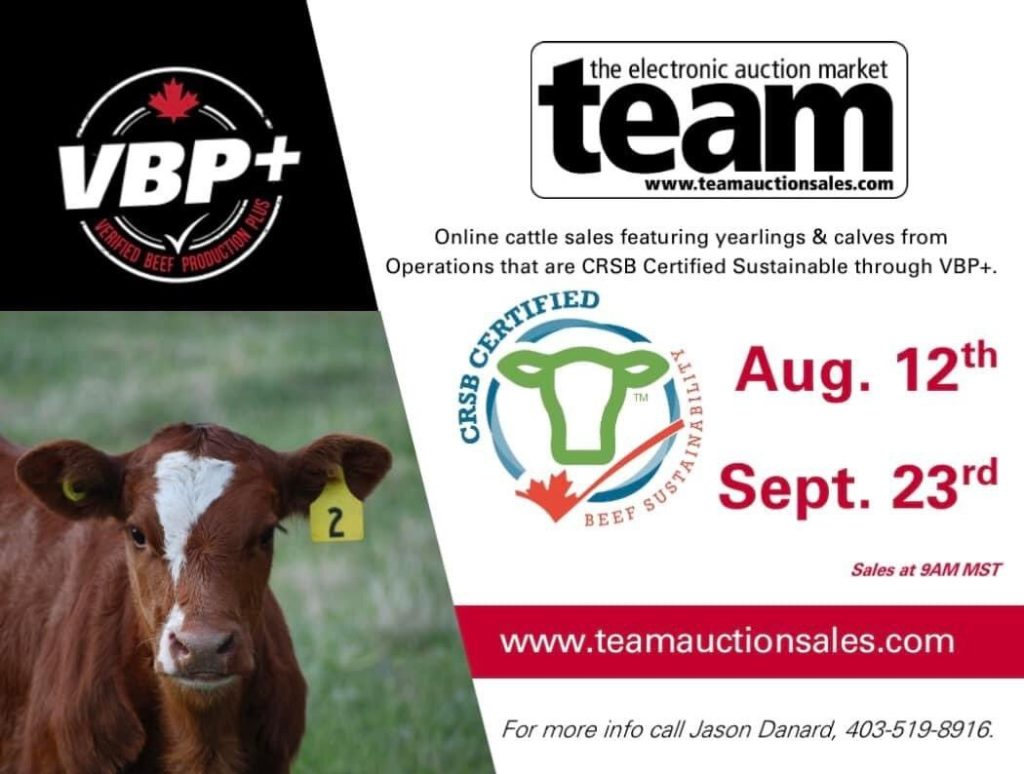
TEAM is hosting a feeder cattle sale featuring cattle from operations with CRSB Certified Sustainable status through VBP+. The sale will start at 9:00am MDT on Friday, September 23rd and will offer both calves and yearlings.

Contact Jason Danard with TEAM to ask further questions or book your cattle into the sale.

Find the sale info here. If you are interested in buying, be sure to check out the details on sale lots and get approved to bid before sale day!

One of the exciting new elements of the Canadian Cattle Learning Centre is the redesigned online VBP+ training modules. However, this new platform isn’t just for new members of the VBP+ program.

Most obviously, training evolves with the changing Canadian beef industry. Certified producers who enroll in the Canadian Cattle Learning Centre can review the new VBP+ training modules to see what has been updated to reflect changes since they took the training. Additionally, operations that seek out additional training outside of the VBP+ program can upload these experiences to their transcript to demonstrate commitment to continuous improvement.

In addition, no one’s memory is perfect! An enrolment fee of $50 secures access to the Canadian Cattle Learning Centre for five years, letting producers come back to the training modules as much as they’d like to review concepts and program requirements. The new training also features self-assessments throughout to help producers track their progress towards meeting all standards. This tool can help certified producers reassess their operations to make sure they are still meeting requirements throughout the five-year audit cycle, particularly before records assessments and self declarations.

The Canadian Cattle Learning Centre is far from complete. In the future, VBP+ will continue to develop and add new training opportunities to the platform, providing centralized access to a variety of learning. A module focusing on the pre-certification process to help prepare new producers and operations seeking re-certification is currently in the works.

Most importantly, the Canadian Cattle Learning Centre has relevance in the big picture of the Canadian beef industry. The Canadian Beef Advisors released a set of nationally framed goals for the industry, which focus on securing environmental, social, and economic security into the future. Many of these goals are targeted at maintaining public trust in the Canadian beef industry.

VBP+ producers already demonstrate commitment to sustainable beef production by meeting program requirements. However, industry advocates need a way to show tangible evidence of the good work of Canadian beef producers to policymakers, consumers, and other stakeholders. Training rates on the Canadian Cattle Learning Centre, as well as producer transcripts, will provide simple metrics to communicate the dedication of Canadian beef producers to continuous improvement as the industry evolves in response to consumer demands.

In general, the Canadian Cattle Learning Centre is a win-win-win situation. Producers gain an easy to access, engaging platform for training and a simple way to track their industry-related education. Industry advocates acquire a simple method for communicating the good work that Canadian farmers and ranchers are already doing. Finally, other stakeholders outside of the industry, including consumers, gain confidence in the safety and sustainability of the Canadian beef on their plates.

To register for the Canadian Cattle Learning Centre, click here.

To learn more about the Canadian Cattle Learning Centre and how to sign up, see the last VBP+ blog post.

Canadian beef producers are always keen to make their operations the best they can be. However, taking time away from the farm to seek out learning opportunities is rarely easy. Luckily, VBP+ has launched the Canadian Cattle Learning Centre to make it easy for ranchers to improve their operations from the comfort of their own homes.

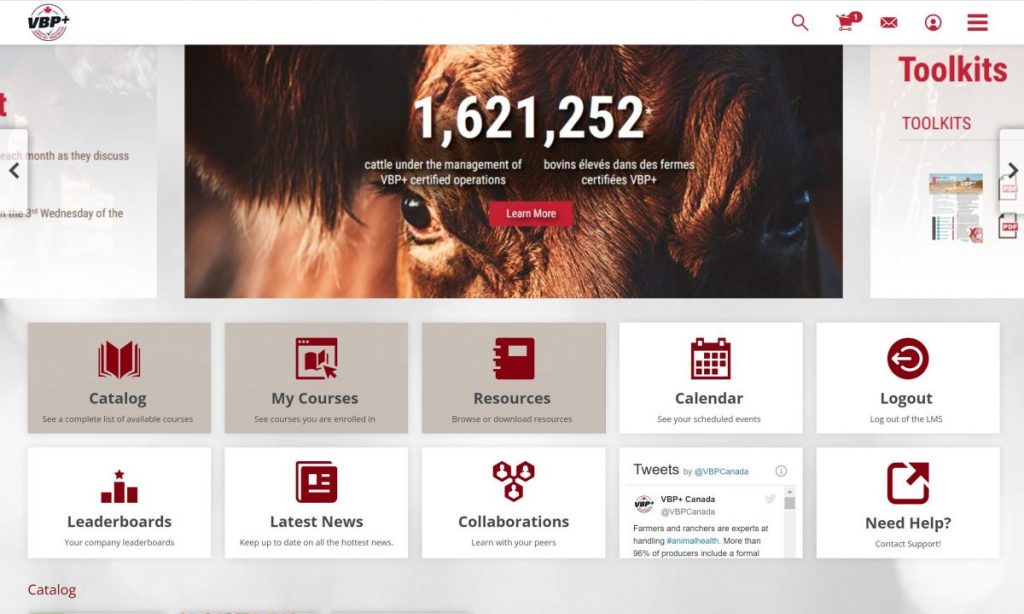
The Canadian Cattle Learning Centre houses the brand new eleven online training modules for the VBP+ program. Producers can take the training at their own pace as they navigate through content which has been refreshed to be more engaging and relevant to the modern industry. The modules include graphics, animations, links to key resources, and interactive activities to make training more effective and more fun!

One of the key features of the new online training is the self-assessment tool. Throughout each module, trainees are presented with questions to reflect on how their operation is doing in relation to key VBP+ program requirements. While responses are not evaluated by auditors, producers can view and print their results to assess their progress towards meeting all requirements for a successful audit.

As well as the VBP+ training modules, producers can also upload other training that they have completed outside of the VBP+ program. The Canadian Cattle Learning Centre compiles these opportunities into a transcript, allowing producers to demonstrate their commitment to continuous improvement on their operations through education. In the future, VBP+ is looking to create additional content to provide more training opportunities directly through the Canadian Cattle Learning Centre.

How to Sign Up

To register for the Canadian Cattle Learning Centre, click here. Follow the sign-up process below:

  1. Hit Log In at the top right corner, then choose Sign Up at the bottom of the pop up menu.
  2. Enter your personal information and click Sign Up.
  3. Enroll in the course Subscription 2022 and pay the $50 enrolment fee for five years of access.
  4. Enroll in the VBP+ 2.0 course to take the online training.

To take the entire course one module at a time, please select the individual modules/lessons. While completing individual modules provides the complete training and includes self-assessments for each module, there is no self-assessment summary provided at the end of each module.

Need Help?

If you have questions about the Canadian Cattle Learning Centre or the new online training, please reach out to your provincial coordinator. These individuals are there to help guide you through the VBP+ program every step of the way and help you achieve success in training and/or certification.

To find the contact information for your provincial coordinator, click here.

Farm Credit Canada (FCC) is working with innovative producers to grow a more sustainable industry. FCC recognizes that sustainability is important to the future of agriculture, and wants to encourage an increase in the number of certified producers. To do so, FCC has opened their Sustainability Incentive Program to eligible customers who are certified through the Canadian Roundtable for Sustainable Beef (CRSB).

fcc

FCC will provide a payment to FCC customers who are CRSB certified through one of the CRSB’s certification bodies, including VBP+. So, VBP+ certified producers can take advantage of this opportunity.

The payment from FCC will be calculated as a portion of their lending with FCC, with a maximum of $2,000 paid per year. Eligible producers can reapply for the incentive payment annually.

Already Certified?

Customers who are already CRSB certified can apply for the program here.

Want to Participate but Aren’t Certified Yet?

The first step to getting certified is being trained. Contact the provincial VBP+ coordinator for your province using the info found here to learn about in-person and online training opportunities. Your provincial coordinator will also guide you through the process of preparing for an audit to get certified.

Once you are trained and are ready to get ready for certification, the next step is contacting VBP+ Delivery Services Inc. (the certification branch of VBP+). Find contact info here.

For an overview of the certification process and five-year audit cycle, click here.

Looking for More Information?

To learn more about the program, click here.

Questions about FCC Sustainability Incentive Program should be directed to:

Jill McAlister, Corporate Communication, Farm Credit Canada

306-540-4840 | jill.mcalister@fcc.ca

The Animal Care section of the new VBP+ Producer Reference Manual is a great resource for producers to brush up on animal management techniques. Like the other sections, Animal Care includes self-assessments for certified operations to check their progress towards meeting the requirements for a successful audit. In addition, this section is packed full of great information on a variety of animal care topics, as well as other resources for producers.

Animal Care in the manual is divided into five parts: NFACC Code of PracticeHandlingProceduresHousing and Facilities, and Reproduction and Calving. Each sub-section contains key information for producers looking to get certified, or who want to learn more about these topics.


The NFACC Code of Practice outlines recommended and required practices for Canadian beef producers. Read it here.

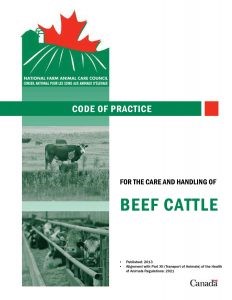
The first sub-section, NFACC Code of Practice, helps producers interpret the structure of this important document. The National Farm Animal Care Council (NFACC) published the new Code of Practice for the Care and Handling of Beef Cattle in 2013. This document upholds the standard for beef cattle management in Canada, and was developed in partnership amongst producers, animal welfare groups, and other stakeholders. Check out the Animal Care section to better understand how to interpret the recommendations and required practices outlined in this document.

Next, the Handling sub-section discusses low-stress cattle handling and its benefits to producers and animals. Specifically, this part of the manual describes specific guidelines for handling tools and principles for animal movement. Additionally, this section ties into the NFACC Code of Practice by providing producers with the recommended handling practices from this document.

Procedures helps producers understand specific guidelines for a variety of common on-farm techniques, including restraint, branding, disbudding/dehorning, castration, weaning, predator control, and tail docking. These components help producers best accomplish these tasks while balancing animal welfare, practicality, efficiency, and effectiveness. For producers new to VBP+ or who want to clarify best practices, this part of the Animal Care section is key. As a bonus, links to several helpful resources from the Beef Cattle Research Council are provided.

The Housing and Facilities sub-section describes how to best manage animal care outside, in confinement, and with specific facilities. This part of the manual lays out key considerations in each of these scenarios and helps producers improve the environment their cattle are exposed to in order to maximize animal health, welfare, and performance.

Finally, Reproduction and Calving Management discusses facilities, monitoring, colostrum, calving issues, and prevention of undesired pregnancies. These topics combined allow producers to improve their calving practices so as to maximize success in terms of calf survival. NFACC guidelines are also provided throughout to help producers note key points from this document.

Together, the sub-sections of Animal Care help producers enhance their cattle management to improve animal health and welfare, which in turn improves performance and profitability for VBP+ operations. Stay tuned for the next section of the VBP+ Producer Reference Manual!

abandoned farmstead in winter

Foreign objects can present a food safety issue for consumers who purchase meat products from affected animals later on down the supply chain, and can also impact animal health and welfare prior to slaughter. Luckily, foreign objects are a risk which producers can mitigate on-farm.

In most cases, foreign objects enter animal carcasses in one of two ways. Cattle can either consume them, or they can penetrate the hide and end up lodging within tissues.

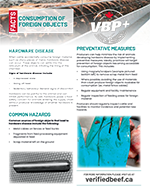
Consumption of foreign objects fact sheet

When cattle consume foreign objects, the material usually gets caught in the reticulum, where it can irritate the tissue within this chamber and cause pain for the animal. At this stage, cattle present a condition called hardware disease, which causes them to perform poorly and show general signs of discomfort such as a depressed state, poor appetite, and sedentary behavior.

Unfortunately, there are many common foreign objects found on-farm which cattle can easily consume. For example, metal cables on fences or feed bunks can be chewed and break if poorly maintained. Alternatively, fragments of metal or other material left on the ground or deposited in feed from processing equipment are easily consumed by cattle.

The best way for producers to prevent the risk of hardware disease, and its associated food safety concern, is to prevent access to foreign objects. If the operation processes feed, magnets or scalpers can be used to remove scrap metal from feed before it is offered to cattle. Where possible, producers should avoid using materials that could easily produce hardware, such as metal fence cables. If this is not possible, producers should regularly maintain equipment and facilities to avoid fragments becoming accessible to animals. Finally, regular inspection of feeding areas for foreign objects and monitoring of cattle and facilities for incidence and new hazards is key.

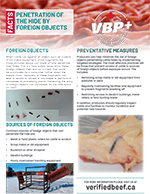
In other cases, cattle do not eat the foreign object, but rather rub against one such that it penetrates their hide. If these foreign objects become lodged in muscle and the producer is not aware, meat containing these foreign objects can enter the food chain and lead to consumer distrust and potential injury. In some cases, recalls or refusals of carcasses or portions of a carcass at processing plants may occur.

Sources of foreign objects that can penetrate cattle hides are relatively similar to those that can cause hardware disease. Scrap metal, derelict buildings, and poorly maintained equipment are easy for cattle to rub against and pick up metal fragments. However, a few common sources are unique to this route of entry. Buckshot or other shrapnel in areas where birds are hunted can enter the animal. Alternatively, metal or hard plastic rollers used for cattle to scratch can deposit small fragments in the hide.

VBP+ penetration of the hide by foreign objects

Much like the hazards, the solutions to foreign objects entering animal hides are very similar to those that prevent the consumption of foreign objects. Removing scrap metal and old equipment and restricting access to derelict buildings, metal or hard plastic rollers, or bird hunting areas will aid in preventing access to fragments that could enter the hide. Regular maintenance of equipment and facilities will also reduce risk. Finally, while preventive measures should be emphasized, producers should monitor and document incidence in cattle to avoid entry of foreign objects into the food supply chain.

Regardless of the route of entry, handling foreign objects with cattle relies on the same basic principle: producers should prioritize prevention and maintain good maintenance and inspection to avoid food safety hazards entering the food supply chain.

To brush up on foreign objects, check out VBP+’s two fact sheets on Consumption of Foreign Objects and Penetration of the Hide by Foreign Objects.

On February 20, 2020, amendments were made to the Health of Animals Regulations: Part XII: Transport of Animals. While the name of this legislation may not ring a bell, most producers caught word of the reduction in maximum allowed intervals without feed, water, and rest for animals in transport. However, this is far from the whole story.

Since the amendments came into effect on February 20, 2020, any animal left at a slaughter facility or assembly centre (i.e. auction market, assembly yard, or independent holding facility associated with a slaughter establishment) had to be accompanied by a written transfer of care document. This document ensures that the individual responsible for the care of the animal(s) in question is clearly identified at all times, which in turn defines who is accountable for welfare decisions.

For some producers, the point at which this regulation came into effect is a source of confusion. The Canadian Food Inspection Agency (CFIA) implemented a two year compliance promotion period for the enforcement of the new maximum feed, water, and rest intervals. This means that until February 20, 2022, CFIA is focusing on education and awareness rather than strict enforcement of the new regulations. However, contrary to what many producers have been told, this does not apply to transfer of care documents. That is, producers are currently required by law to implement this documentation.

The guidelines for these written documents are quite general. There is no prescriptive format for the document, but instead, CFIA provides a list of required information to be included. The necessary information includes:

  1. The names of the transporting company and driver;
  2. The receiving company and representative;
  3. The condition of the animal(s) on arrival;
  4. The date, time, and place of the last feed, water, and rest;
  5. The date, time, and place of arrival;
  6. Notes regarding animal welfare concerns, dead animals found, and resulting actions;
  7. Acknowledgement from the receiver indicating receipt of the animal(s) and acceptance of the responsibility for care.

Producers do not have to provide transfer of care documents to commercial carriers, because responsibility for animal care is already transferred to the transporter upon release of the animals by the producer under the Health of Animals Regulations. As a result, a driver can refuse to drop off a load due to animal welfare concerns, since they are responsible for the care of the animals at that time. Similarly, receivers should document any welfare concerns on arrival to avoid being held accountable for issues that occurred before they were responsible for the care of the animal(s). Notably, CFIA states that this is an important step, because it helps receivers avoid declining a load and prolonging non-compliant animal transport to avert blame for the welfare issues.

Transfer of care documents should be kept on file for two years. This rule is important to tracking accountability for care in case of a welfare investigation. Read the amendments to the Health of Animals Regulations here.

Luckily, VBP+ provides a template for a transfer of care document that is available to all producers, whether or not they are trained and/or certified in the VBP+ program. This helps producers save time and get their cattle passed on quickly and responsibly!

Find the VBP+ Transfer of Care Record template here.

Check out all the record templates and examples that VBP+ offers here.